World
France in Chaos: Historic City Hall Torched as Nationwide Riots Erupt
Hundreds of thousands demonstrate as violent groups attack police, loot businesses and target public buildings, leaving France facing a major public security crisis.
Staff Writer
18 oct 2026
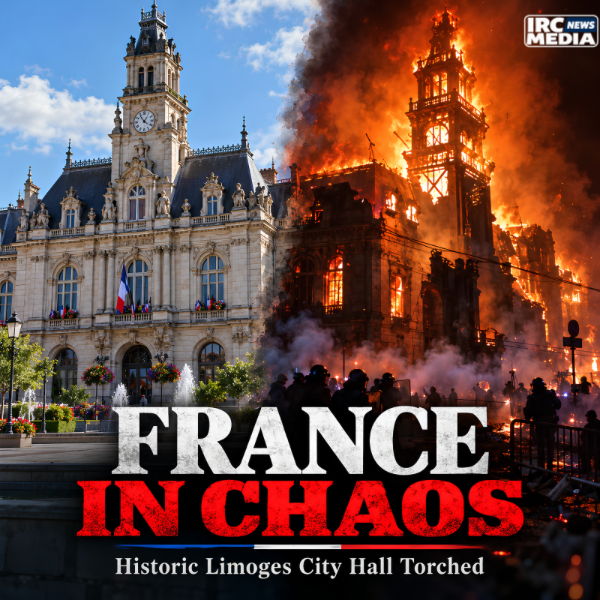
PARIS, France — A historic French city hall has been reduced to charred ruins, police officers have been injured by the hundreds, and businesses across the country are assessing widespread damage following a day of extraordinary violence that swept through major French cities on Saturday, October 17.
What began as nationwide demonstrations against rising living costs, deteriorating school conditions and government policies escalated into serious riots involving arson, organized attacks on law enforcement, looting and destruction of public property.
By Sunday, October 18, French authorities had reported more than 2,000 arrests and more than 600 injured officers, according to Reuters. A demonstrator also died after suffering a cardiac arrest during the protests in Paris. Those figures reflect developing reports and may change.
The unrest has intensified concerns about France’s ability to maintain public order, protect its institutions and respond to increasingly confrontational political movements.
A Historic Landmark Goes Up in Flames
Perhaps the most devastating image of Saturday’s violence emerged from Limoges, a city in central France, where masked individuals attacked the historic City Hall and set the building ablaze.
Constructed in the 19th century and inaugurated in 1883, the elaborately designed municipal building had survived two world wars and remained one of the city’s most recognizable landmarks.
That history offered little protection Saturday evening.
According to French authorities and eyewitness accounts, attackers smashed windows and forced their way into the building before starting a fire that rapidly spread through the structure.
Flames consumed the roof, which collapsed onto the floors below. The building’s prominent clock tower also fell as firefighters struggled to contain the destruction.
The prefect of Haute-Vienne, Maurice Barate, described the loss as a catastrophe for the city’s architectural heritage.
Limoges Mayor Guillaume Guérin sharply criticized the lack of available police protection, arguing that security forces had already been overwhelmed by violence elsewhere in the city.
The mayor also raised concerns that the attack appeared organized rather than spontaneous, describing individuals using coordinated tactics and equipment to breach the building.
Prosecutors have opened a criminal investigation. Authorities must still establish who was responsible for the fire and what role individual suspects may have played.
Police Targeted as Violence Spreads
Limoges was far from the only city experiencing serious disturbances.
In Paris, masked groups confronted riot police near Place de la République, launching projectiles, firework mortars and incendiary devices while officers responded with tear gas and water cannons.
Firework mortars are pyrotechnic devices that can cause serious injury when deliberately fired toward people. They should not be confused with military mortar weapons.
Elsewhere, demonstrators forced their way into Marseille’s City Hall and damaged municipal property. In Lyon, a tourist office was set ablaze. Bordeaux experienced significant looting and attacks on property.
Across several cities, police vehicles were attacked, storefronts shattered and businesses ransacked.
French officials reported that the rapidly moving groups and simultaneous disturbances stretched available police resources, sometimes leaving officers unable to respond immediately to additional attacks.
The violence left substantial damage in major commercial districts and renewed questions about whether security forces had adequate personnel and equipment to protect public spaces.
Who Is Behind the Violence?
French Interior Minister Laurent Nuñez has attributed much of the organized violence to radical far-left groups, with other individuals allegedly exploiting the disorder to loot businesses.
Prime Minister Sébastien Lecornu also condemned those responsible, accusing violent groups of attempting to undermine the country’s institutions during an increasingly tense political period.
However, investigators must still establish the identities and individual responsibility of those who committed specific crimes.
Videos circulating internationally have prompted allegations that immigration and failures of border enforcement were responsible for the violence. French authorities have not established that immigrants were behind the unrest, and those claims should not be treated as proven.
The immediate protest movement developed from student complaints about schools and broader public frustration over the cost of living and government spending.
Saturday’s demonstrations attracted approximately 550,000 participants according to French authorities, while organizers estimated attendance closer to 800,000.
The overwhelming majority of those participating in organized demonstrations were not reported to have engaged in violence.
That distinction matters as France attempts to identify and prosecute those who used otherwise lawful public gatherings as opportunities for destruction.
France’s Political Divisions Deepen
The violence comes as President Emmanuel Macron approaches the final months of his presidency, with France preparing for its 2027 presidential election.
Political tensions have grown over the economy, the cost of living, government spending, policing and the direction of the country.
Saturday’s events have added another urgent question: Can France protect the right to protest while preventing organized groups from overwhelming law enforcement and attacking public institutions?
Macron condemned the destruction and pledged accountability for those responsible.
Opposition figures have offered competing explanations for the unrest, with some blaming radical political movements and others criticizing the government’s handling of demonstrations and police operations.
Meanwhile, concerns about police tactics have continued following serious injuries to demonstrators during recent protests, adding another layer of controversy to the government’s security response.
For residents and business owners left facing destruction, however, the immediate concerns are more practical: safety, restoration of public services, rebuilding and the financial consequences of the violence.
A Nation Facing Difficult Questions
The destruction of Limoges City Hall represents more than the loss of a historic building.
It symbolizes a frightening breakdown in public security at a time when France is already confronting deep political and economic divisions.
The right to peaceful demonstration remains fundamental to a democratic society. But attacks on police, deliberate arson, destruction of public buildings and organized looting are criminal acts, regardless of the political ideology behind them.
As investigators identify suspects and government officials assess the damage, France faces a growing challenge: restoring public confidence in the institutions responsible for protecting its people.
For the residents of Limoges, that challenge now begins in the shadow of a landmark that stood for more than 140 years before being consumed by fire in a single night.
Cover image: AI-generated editorial illustration; it is not a documentary photograph of the October 17 fire.