U.S.
Ukraine Says U.S. Missile Intelligence Was Restored; Rubio Denies Any Pause
Zelenskyy reports a three-day gap in ballistic-missile warnings as new Russian strikes, a sanctions waiver and difficult peace talks deepen the dispute.
Staff Writer
19 oct 2026
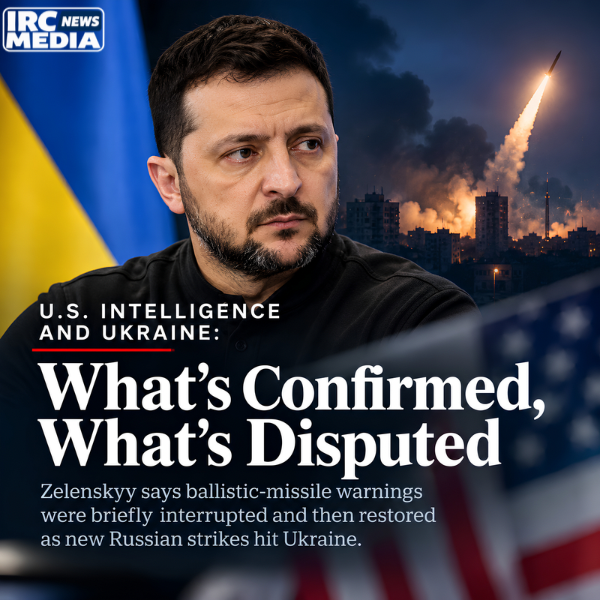
WASHINGTON — A dispute over American intelligence support for Ukraine intensified Monday, October 19, when Secretary of State Marco Rubio denied that Washington had interrupted intelligence sharing, contradicting Ukrainian President Volodymyr Zelenskyy’s account of a three-day gap in warnings about Russian ballistic missiles. The disagreement emerged as another Russian attack battered Ukraine’s electricity network and renewed questions about the Trump administration’s approach to ending the war.
Zelenskyy told NBC’s Meet the Press on Sunday that U.S. intelligence critical to detecting ballistic-missile launches had been temporarily blocked and subsequently restored. He expressed gratitude that the information was flowing again. But on Monday, Rubio told reporters in Uzbekistan there had been no pause. The conflicting public accounts leave a central question unresolved: Was a particular warning capability interrupted even while other intelligence cooperation continued?
The disputed three-day gap
In the October 18 interview, Zelenskyy said Ukraine had gone three days during ballistic-missile attacks without receiving the specialized information he said only the United States could provide. He did not publicly establish the precise start and end times of the interruption, identify the intelligence channels involved, or say who ordered any restriction. Reuters reported his remarks as an account of resumed sharing, not as independent confirmation of a U.S. suspension order.
Washington’s account is different. President Donald Trump had already maintained that American intelligence sharing continued. Rubio went further October 19, saying there had been no interruption and challenging Zelenskyy’s public description. Neither government has published operational records that would allow outsiders to reconcile the statements. A missing advance warning for a particular attack is not necessarily evidence that all intelligence assistance stopped.
The concern predates Sunday’s interview. On October 14, Ukraine’s presidential office said Zelenskyy had told Canadian Prime Minister Mark Carney that Kyiv had not received advance warning of a Russian ballistic-missile strike, the second such instance that week. The Ukrainian statement reported one death and six injuries in that attack at the time, along with damage to a residential building and power facility.
Why missile warnings matter
The stakes rose again overnight into October 19. According to the Associated Press, Zelenskyy said a Russian barrage involving ballistic missiles and drones damaged more than 10 energy facilities, leaving over half a million people without essential services. Ukrainian officials reported that a 21-year-old woman was killed in Kyiv. Zelenskyy said 16 ballistic missiles had been launched at the capital and surrounding region and again complained that partner countries had provided no early warning.
Early detection can give Ukrainian authorities and air-defense crews additional time to issue alerts, prepare interceptors and direct civilians toward shelter. Ballistic missiles travel rapidly, making warning time especially valuable. Yet intelligence by itself cannot intercept a missile; Ukraine also needs functioning air-defense systems and sufficient interceptors. Zelenskyy pressed European leaders on October 16 for more Patriot missiles as Russia escalated its attacks on energy infrastructure.
There is no publicly verified evidence establishing that the October 14 or October 19 casualties or damage were caused by absent American warnings. Nor has Washington disclosed enough about the specific information supplied to determine what alerts Ukraine should have received on either night. That distinction is essential to assessing the competing claims fairly.
Trump’s sanctions decision and peace strategy
The intelligence dispute coincides with a major U.S. policy decision. On October 16, Trump signed an executive order waiving new sanctions and tariffs authorized by the Lindsey O. Graham Sanctioning Russia and Iran Act of 2026, which he signed into law in September. The order invokes the statute’s national-interest waiver and says the required certification was submitted to Congress. Importantly, the text preserves preexisting sanctions imposed under earlier executive orders; it does not erase every U.S. restriction on Russia.
Rubio has described a review of up to 60 days to evaluate the economic consequences of the new measures. Trump has defended preserving room for negotiations with Moscow rather than taking steps he believes could drive Russia away from talks. His administration has also announced a deal for Russian diesel supplies intended to ease energy prices, prompting criticism that greater Russian fuel revenue could support Moscow’s war effort. The commercial announcement should not be confused with proof that all proposed deliveries have occurred.
Trump argues the war must end through diplomacy. Treasury Secretary Scott Bessent told Meet the Press that the United States continues helping Ukraine through intelligence cooperation and American munitions sold to other countries for transfer to Kyiv. He emphasized a negotiated settlement rather than treating outright Ukrainian military victory as the prerequisite. No final agreement resolving territory, security guarantees or enforcement has been announced.
Ukraine’s response and separate satellite dispute
Zelenskyy fears that relief from sanctions and pressure on Kyiv’s strikes against Russian energy targets will reduce Moscow’s incentive to compromise. In his NBC interview, he warned against the United States aligning itself with Russia, while saying he still hoped Trump would remain supportive. Ukraine’s presidential office said Zelenskyy spoke October 18 with U.S. envoys Steve Witkoff and Jared Kushner and described continuing diplomatic contacts, even amid the public disagreement.
There is also a separate dispute over restrictions involving SpaceX’s military-grade Starshield satellite communications services. Ukraine says limits have affected its operations; American officials have disputed allegations of U.S. involvement. Starshield connectivity is not the same service as government-provided missile-launch intelligence. Neither controversy should be treated as proof of the other.
America’s interests and Congress’s response
For the United States, the issue reaches beyond a single foreign aid decision. Intelligence cooperation can help Ukraine resist Russian attacks, inform U.S. assessments of Moscow’s military operations and affect confidence among NATO allies watching threats near the alliance’s eastern borders. Ukraine is not a NATO member, and American intelligence support does not create an Article 5 treaty obligation to defend it. The scope, costs and risks of assistance remain legitimate subjects for congressional oversight.
Lawmakers are divided over the direction of U.S. policy, though criticism of the sanctions waiver crosses party lines. Republican Senators Rick Scott and Thom Tillis argued that Washington should maintain pressure on Russia; Democratic Senator Richard Blumenthal also condemned the waiver. Republican Senator Darline Graham acknowledged the president’s legal discretion while saying she personally favored continued pressure. Republican Representative Thomas Massie welcomed the waiver. Congress is in recess until after the November 3 elections, limiting any immediate legislative response.
Supporters of sustained assistance argue that credible pressure on Russia and reliable defensive intelligence strengthen U.S. bargaining power without requiring American troops to fight in Ukraine. Advocates of a narrower role emphasize American costs, escalation risks, Europe’s responsibilities and the urgency of reaching a settlement. Both positions require scrutiny of outcomes, not merely assurances from either capital.
The immediate accountability test is straightforward: Washington and Kyiv need to clarify what missile warnings were available, whether any specific channel changed, and how future civilian alerts will be protected. Until those facts are documented, the reported restoration remains Ukraine’s account, the denial remains Washington’s, and Russian attacks continue regardless of their disagreement.
Advertise here
IRC Media uses aggregated public data and verified sources; articles reviewed by editorial team to the best of our ability.