Florida
Florida Dengue Outbreak Grows to 252 Local Cases — What Indian River County Residents Need to Know
Florida’s latest arbovirus report shows locally acquired dengue in seven counties, led overwhelmingly by Hillsborough County. Indian River County has no reported locally acquired dengue case in 2026, but local mosquito surveillance remains active.
Staff Writer
3 de out. de 2026
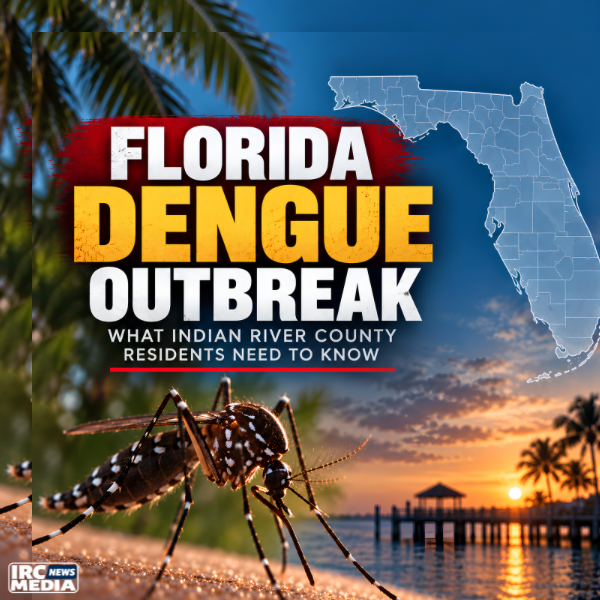
Florida has recorded 252 locally acquired dengue cases in 2026 through Sept. 26, according to the Florida Department of Health’s latest available weekly arbovirus surveillance report. The cases have been reported from seven counties, with Hillsborough County accounting for 223 — nearly nine out of every 10 locally acquired cases statewide.
For residents of Indian River County and the Treasure Coast, the important distinction is this: the latest state surveillance report does not list Indian River County, St. Lucie County, Brevard County, Martin County or Okeechobee County among counties with locally acquired dengue in 2026.
That does not mean mosquito-borne disease activity is absent from the region. Florida’s surveillance program has detected West Nile virus activity in sentinel chickens in Indian River, Brevard and St. Lucie counties, and Martin County issued a mosquito-borne illness advisory on Oct. 1 after several sentinel chickens tested positive for West Nile virus. Those findings are separate from dengue.
Statewide dengue picture
Florida’s Week 38 arbovirus report, covering Sept. 20–26, lists 252 locally acquired dengue cases in seven counties:
Hillsborough: 223
Pinellas: 13
Miami-Dade: 8
Orange: 3
Pasco: 3
Palm Beach: 1
Polk: 1
The same report lists 245 travel-associated dengue cases in Florida in 2026. Travel-associated cases are people infected while traveling in a dengue-risk area; locally acquired cases are infections believed to have occurred in Florida.
Florida’s report also states that 20 mosquito pools have tested positive for dengue virus in 2026. The positive pools listed in the report were Aedes aegypti mosquitoes in Hillsborough and Pasco counties.
The state report includes confirmed and probable cases but excludes suspect cases. Florida maps cases by county of exposure, while CDC national surveillance generally reports cases by county of residence, so the two systems are not always directly comparable.
What We Know in Indian River County
As of the latest state report available Saturday, Oct. 3, Indian River County has no reported locally acquired dengue case in 2026.
The Florida Department of Health in Indian River County says it works with the Indian River Mosquito Control District on mosquito-borne disease surveillance. The local program uses sentinel chickens placed throughout the populated eastern portion of the county and tested for evidence of mosquito-borne viruses.
The latest state arbovirus report shows four Indian River County sentinel chickens testing positive for West Nile virus antibodies from samples collected Sept. 10. It also lists earlier Eastern equine encephalitis activity in the county. Those findings do not represent dengue infections in people and should not be confused with the current dengue outbreak elsewhere in Florida.
The latest state report also does not identify locally acquired dengue in St. Lucie, Brevard, Martin or Okeechobee counties. St. Lucie County has reported travel-associated dengue cases this year, but those are not classified as local transmission.
IRC Media found no current dengue-specific alert or advisory posted by DOH-Indian River and no public indication that the Indian River Mosquito Control District has launched a special dengue response beyond its established mosquito and disease surveillance operations. If local agencies announce additional trapping, testing, spraying or targeted treatment, that would represent a change from the publicly available information reviewed for this report.
How Dengue Spreads
Dengue is caused by one of four related dengue viruses and is spread primarily through the bite of an infected Aedes mosquito, especially Aedes aegypti. Aedes albopictus can also transmit dengue.
Dengue does not normally spread directly from one person to another. A mosquito can become infected after biting a person who has dengue virus in their blood and can later transmit the virus to another person.
Because Aedes mosquitoes often live around homes and can breed in small amounts of standing water, controlling containers and other water-holding objects around homes is an important part of prevention.
Symptoms and Warning Signs
According to CDC, about one in four dengue infections causes symptoms. Illness commonly begins after an incubation period of about five to seven days, although symptoms can appear within roughly two weeks after an infected mosquito bite.
Common symptoms can include fever, severe headache, pain behind the eyes, muscle and joint pain, nausea, vomiting and rash.
Most people recover, but approximately one in 20 people who become sick with dengue can develop severe dengue.
Warning signs that require prompt medical attention include severe abdominal pain or tenderness, persistent vomiting, bleeding from the nose or gums, vomiting blood, blood in the stool, unusual tiredness or restlessness, or signs of shock. Warning signs can appear as the fever begins to go away.
People who develop fever or other dengue-like symptoms after mosquito exposure or recent travel to a dengue-risk area should contact a health care provider and provide their travel history.
A previous dengue infection does not guarantee protection from future dengue illness because there are four dengue virus types. Infection with one type generally provides long-term protection against that type, but a later infection with a different type can carry a greater risk of severe dengue.
CDC says there is currently no dengue vaccine available for use in the United States. Dengvaxia, which had been recommended for a narrow group of children with laboratory-confirmed previous infection living in areas where dengue is endemic, has been discontinued and is no longer available in the U.S.
How to Protect Your Home and Family
Florida health officials continue to emphasize the “Drain and Cover” approach.
Drain standing water from buckets, flowerpots, trash cans, pool covers, toys, gutters, coolers and other containers that collect rain or irrigation water. Aedes mosquitoes can reproduce in relatively small amounts of water.
Cover skin with long sleeves, long pants, shoes and socks when practical, particularly when mosquitoes are active.
Use an EPA-registered insect repellent and follow the label directions. Parents and caregivers should follow age-specific label instructions for children and should not apply repellent to a child’s hands, eyes, mouth, cuts or irritated skin.
Keep doors and windows screened and repair holes in screens. Use air conditioning when available.
Keep yards and outdoor areas free of containers that hold water. Pet bowls, birdbaths and similar containers should be emptied, scrubbed and refilled regularly. Mosquito repellents intended for humans should not be applied to pets unless the product label specifically allows it; pet owners should consult a veterinarian about appropriate protection.
What Local Mosquito Officials Are Doing
Indian River County already has an established mosquito-borne disease surveillance system. DOH-Indian River says the county partners with the Indian River Mosquito Control District, including a sentinel chicken program that monitors for arboviruses.
The state’s latest data show that surveillance is detecting mosquito-borne virus activity locally — specifically West Nile virus and Eastern equine encephalitis indicators — even though no locally acquired dengue case is listed for Indian River County.
IRC Media also reviewed the current statewide surveillance data for evidence of a dengue-specific escalation in Indian River County. No such escalation was identified in the public material reviewed.
The district’s current budget and staffing may affect how much surveillance and treatment capacity it can maintain over time, but IRC Media found no evidence in the available public record that current budget conditions have created a documented gap in dengue preparedness. Any future claim of reduced readiness would require direct support from district operational data or board records.
What Happens Next
Florida’s locally acquired dengue count is provisional and can change as investigations and laboratory results are completed.
For Indian River County, the immediate public-health picture remains one of heightened awareness rather than confirmed local dengue transmission. Residents should distinguish between the large outbreak centered elsewhere in Florida and the mosquito-borne disease activity already being monitored on the Treasure Coast.
The practical message is simple: remove standing water, prevent mosquito bites and pay attention to official health alerts. If locally acquired dengue is confirmed on the Treasure Coast, county health officials and mosquito-control agencies would be expected to increase investigation, targeted mosquito control and public notification.
Fact Box
Florida locally acquired dengue cases in 2026: 252 through Sept. 26
Counties with local dengue transmission: 7
Highest total: Hillsborough County, 223
Travel-associated Florida dengue cases in 2026: 245
Indian River County locally acquired dengue cases: 0 reported in latest state surveillance
St. Lucie locally acquired dengue cases: 0 reported; travel-associated cases have been reported
Brevard locally acquired dengue cases: 0 reported in 2026
Martin locally acquired dengue cases: 0 reported in latest state surveillance
Okeechobee locally acquired dengue cases: 0 reported in latest state surveillance
Indian River sentinel surveillance: West Nile virus activity detected in chickens; this is not dengue
Advertisement