U.S.
Supreme Court Allows Trump Administration to Resume Third-Country Deportations as Legal Fight Continues
Justices temporarily lift lower-court restrictions while considering what protections migrants must receive before removal to countries other than their own.
Staff Writer
29 de set. de 2026
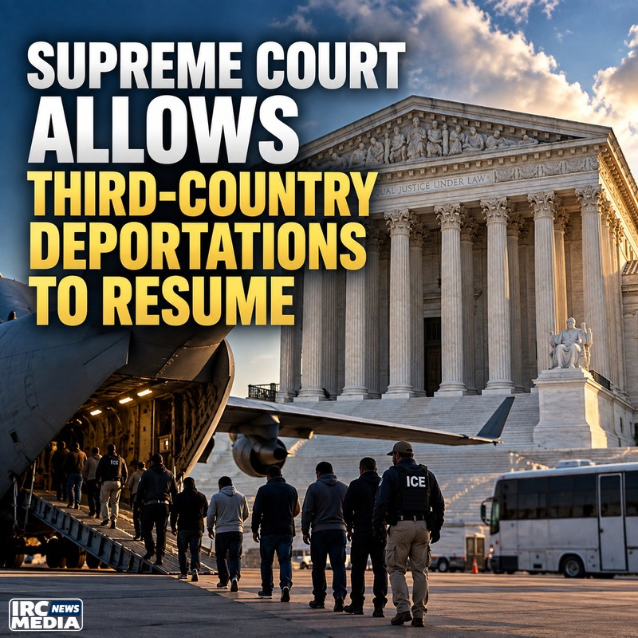
WASHINGTON — The U.S. Supreme Court on Tuesday allowed the Trump administration to resume deporting some migrants to countries other than their countries of origin while the justices consider a broader legal challenge to the administration’s third-country removal policy.
The Sept. 29 order does not amount to a final Supreme Court ruling that the policy is lawful. Instead, the Court granted the administration’s request for emergency relief from a lower-court order, allowing the government to continue using third-country removals while the case proceeds.
The vote was 6-3. Justices Sonia Sotomayor, Elena Kagan and Ketanji Brown Jackson dissented.
At the center of the dispute is whether people facing removal to a country other than the one identified in their original removal proceedings must first receive meaningful notice and an opportunity to argue that they could face persecution, torture or other serious harm there.
The Supreme Court is expected to hear the broader case in December.
What Is A Third-Country Deportation?
A third-country deportation occurs when the United States removes a person to a country other than that person’s country of nationality or origin.
The government has increasingly relied on such arrangements when a person’s home country will not accept the individual or when removal there is otherwise unavailable.
According to reporting by The Associated Press and Reuters, the administration has used third-country arrangements to remove roughly 25,000 people to more than two dozen countries. Mexico has received a large share of those deportees, while other arrangements have involved countries in Africa and elsewhere.
Administration officials say the policy is an important immigration-enforcement tool, particularly when deportees cannot be returned to their home countries. The Justice Department has argued that lower courts improperly restricted the executive branch’s authority to carry out lawful removal orders.
Attorneys challenging the policy argue that people must be given sufficient notice and a meaningful chance to raise safety concerns before being sent to an unfamiliar country. They contend that rapid removals can leave little or no practical opportunity to challenge a transfer before a deportation flight departs.
The Lower-Court Fight
The case is Department of Homeland Security v. D.V.D.
On Sept. 24, the Trump administration filed an emergency application asking the Supreme Court to stay a February 2026 order from the U.S. District Court for the District of Massachusetts. In its application, the government called third-country removals an “essential tool” for enforcing removal orders and argued that the lower court had improperly limited the Department of Homeland Security’s authority.
The lower-court litigation had required additional procedural protections before some third-country removals could take place.
The dispute intensified after an intended deportation flight involving dozens of people was disrupted by the litigation. The administration argued that the lower-court order interfered with diplomatic agreements and operational planning. Attorneys for the migrants argued that the procedures were necessary to prevent people from being sent to countries where they could face severe harm.
Tuesday’s Supreme Court order puts those lower-court restrictions on hold for now.
More Countries Involved
The ruling comes as the United States continues working with additional countries willing to accept deportees who may have no previous connection to those nations.
The Associated Press reported Tuesday that Burundi had agreed to accept some people deported from the United States, though significant details of that arrangement, including timing and the number of people involved, remained unresolved.
Reuters also reported this week that United Nations human-rights experts had urged the United States to halt third-country removals, warning that some deportees could face heightened risks of abuse, persecution or torture. The Trump administration maintains that its policy is lawful and says it obtains diplomatic assurances in appropriate cases.
What The Supreme Court Has — And Has Not — Decided
The most important distinction in Tuesday’s order is what it does not decide.
The Supreme Court has not yet issued a final ruling on whether the Trump administration’s third-country deportation policy complies with federal immigration law or with legal protections designed to prevent people from being removed to countries where they could face torture or persecution.
For now, the Court has allowed the administration to continue the policy while that legal question is litigated.
The justices are expected to hear fuller arguments in December, when both the government and challengers will have an opportunity to address the policy’s legality and the scope of the lower courts’ authority to restrict it.
Until then, third-country deportations may continue under the Supreme Court’s temporary order.
Sources: U.S. Supreme Court; Associated Press; Reuters.

IRC Media uses aggregated public data and verified sources; articles reviewed by editorial team to the best of our ability.