World
U.S. Pulls 12 B-1 Bombers From UK Base as Terror Investigation Raises Force-Protection Concerns
President Trump says a threat factored into the move from RAF Fairford, while British counterterrorism police continue investigating six suspects and possible foreign-state involvement. Iran denies any role.
Staff Writer
5 de out. de 2026
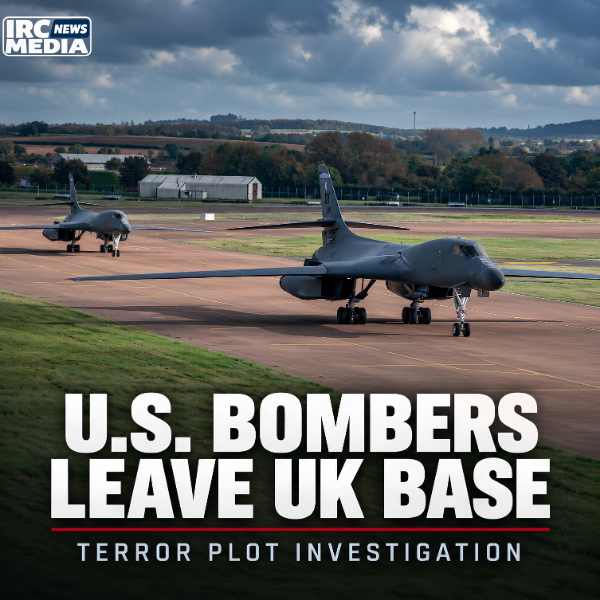
The United States has withdrawn all 12 B-1B Lancer bombers that had been operating from RAF Fairford in the United Kingdom as British counterterrorism authorities investigate suspicious activity near the strategically important air base and possible foreign-state involvement.
The aircraft movement is confirmed. The arrests are confirmed. But investigators have not publicly established that Iran directed the suspected activity, and no suspect has been convicted or formally charged.
President Donald Trump said a threat factored into the decision to move the bombers, telling reporters that U.S. officials had an indication there could be a threat and questioning why the aircraft should remain there. Vice President JD Vance described the withdrawal as a precautionary action.
Secretary of State Marco Rubio offered a more guarded assessment, saying military assets are routinely repositioned and cautioning against assuming every aircraft movement was directly tied to the investigation.
What happened near RAF Fairford
British police were called shortly after 12:45 a.m. on Sept. 27 after reports of three suspicious vehicles traveling toward RAF Fairford.
Armed officers responded in the Whelford area, roughly a mile from the base, and arrested five men. Counter Terrorism Policing said the men were British nationals between the ages of 23 and 25 who lived in London.
The suspects were initially detained on suspicion of offenses under Britain's Explosives Act and were subsequently arrested on suspicion of preparing an act of terrorism.
Police extensively searched the vehicles with forensic and military assistance. Authorities said no improvised explosive devices were found. Investigators did recover a quantity of petrol.
A sixth suspect, identified by police as a dual British-Iranian national, was arrested in Westminster, London, on Oct. 1 on suspicion of preparing terrorist acts.
All six arrested suspects have been released on police bail while the investigation continues. As of Monday, Oct. 5, authorities had not publicly announced formal charges against them.
Was RAF Fairford the intended target?
The arrests clearly involved suspicious activity near RAF Fairford, and the vehicles were reported traveling toward the airfield.
However, British police have not publicly announced that investigators have conclusively established a completed attack plan against the base.
Counter Terrorism Policing has said investigators are examining all possible angles, including possible foreign-state involvement.
That distinction matters. Suspicion that the base may have been targeted is part of an active investigation, not a proven fact established in court.
Iran allegations remain disputed
President Trump has publicly suggested the suspected threat could be linked to Iran, and British officials have discussed possible Iranian involvement.
Iran denies involvement.
British investigators have not publicly established Iranian responsibility as fact. Prior Iranian warnings involving military bases used in operations against Iran may be relevant to the broader security environment, but those statements alone do not prove Tehran directed the activity that led to the Sept. 27 arrests.
Twelve B-1 bombers leave Fairford
The Pentagon confirmed that the 12 B-1B Lancer bombers deployed at RAF Fairford departed on Oct. 4 and returned to their home stations in the United States.
The B-1 fleet operates primarily from Dyess Air Force Base in Texas and Ellsworth Air Force Base in South Dakota.
The publicly available Pentagon confirmation did not provide a plane-by-plane destination for every aircraft.
The large B-1 presence at Fairford had been established before the arrests. U.S. officials have not publicly said the deployment itself was originally created in response to the security investigation.
It also remains important to distinguish the end of the bomber deployment from the continuing U.S. military presence at Fairford. The Pentagon's confirmation concerned the B-1 aircraft and did not state that every American aircraft, unit or support element had departed the base.
Why RAF Fairford matters
RAF Fairford in Gloucestershire is one of the most important airfields available to U.S. forces in Europe.
Its long runway and supporting infrastructure allow the installation to accommodate American heavy bombers, including the B-1B, B-52 and other large military aircraft.
The United States does not permanently base its strategic bomber force at Fairford. Instead, aircraft deploy there periodically for exercises, deterrence missions, operational support and rapid-response positioning.
Fairford gives American bombers a forward operating location much closer to Europe, the Middle East and surrounding regions than their permanent bases in the continental United States.
The B-1's role
The B-1B Lancer is a long-range conventional bomber designed to carry large quantities of precision-guided and standoff weapons.
The aircraft no longer performs a nuclear mission for the United States.
B-1 deployments to Europe allow U.S. crews to train with allies, demonstrate long-range strike capability and position aircraft closer to areas where they may be needed.
Fairford has also supported U.S. military activity connected to Europe and the Middle East.
Does the withdrawal reduce U.S. strike capability?
Moving the bombers out of Fairford changes their immediate positioning, but it does not eliminate America's long-range bomber capability.
The United States retains B-1, B-2 and B-52 forces capable of launching from other bases, including installations in the continental United States.
Operating from farther away can increase flight time and tanker requirements for some missions, but the Fairford departure should not be interpreted as the United States losing strategic strike capability.
U.S. and NATO officials have not announced that the withdrawal has materially reduced the alliance's overall defensive capability.
A force-protection concern
The developing case is significant because it highlights the challenge of protecting high-value U.S. military assets overseas.
A concentration of strategic aircraft at a fixed installation presents an obvious force-protection concern when authorities receive credible information about a possible threat.
Aircraft can be dispersed relatively quickly, while investigators and military commanders assess whether a threat is credible, organized or connected to a foreign state.
Trump's explanation indicates that protecting the aircraft and personnel factored into the Fairford decision.
Public reporting has described heightened security around the installation, but IRC Media has not identified a public Pentagon announcement establishing a new Defense Department-wide force-protection level specifically because of the Fairford investigation.
What is confirmed — and what is not
Confirmed:
Twelve U.S. B-1B bombers departed RAF Fairford on Oct. 4 and returned to the United States.
Five British men were arrested near the base on Sept. 27.
A sixth dual British-Iranian national was arrested in London on Oct. 1.
Police recovered a quantity of petrol.
Police said no improvised explosive devices were found.
All six arrested suspects were released on bail while the investigation continues.
Not publicly established:
That Iran ordered or directed the suspected activity.
That investigators recovered a viable explosive device.
That the suspects had completed a workable attack plan.
That RAF Fairford has been conclusively established as the intended target.
That any of the suspects has been formally convicted of an offense.
The investigation remains active, and additional facts could change the picture as British authorities continue their work.