Local
Cleveland Clinic Plans Two New Emergency Departments in Indian River County
Proposed 24-hour sites in Sebastian and South Vero Beach raise questions about access, emergency-room costs and a separate plan for a third hospital.
Staff Writer
17 oct. 2026
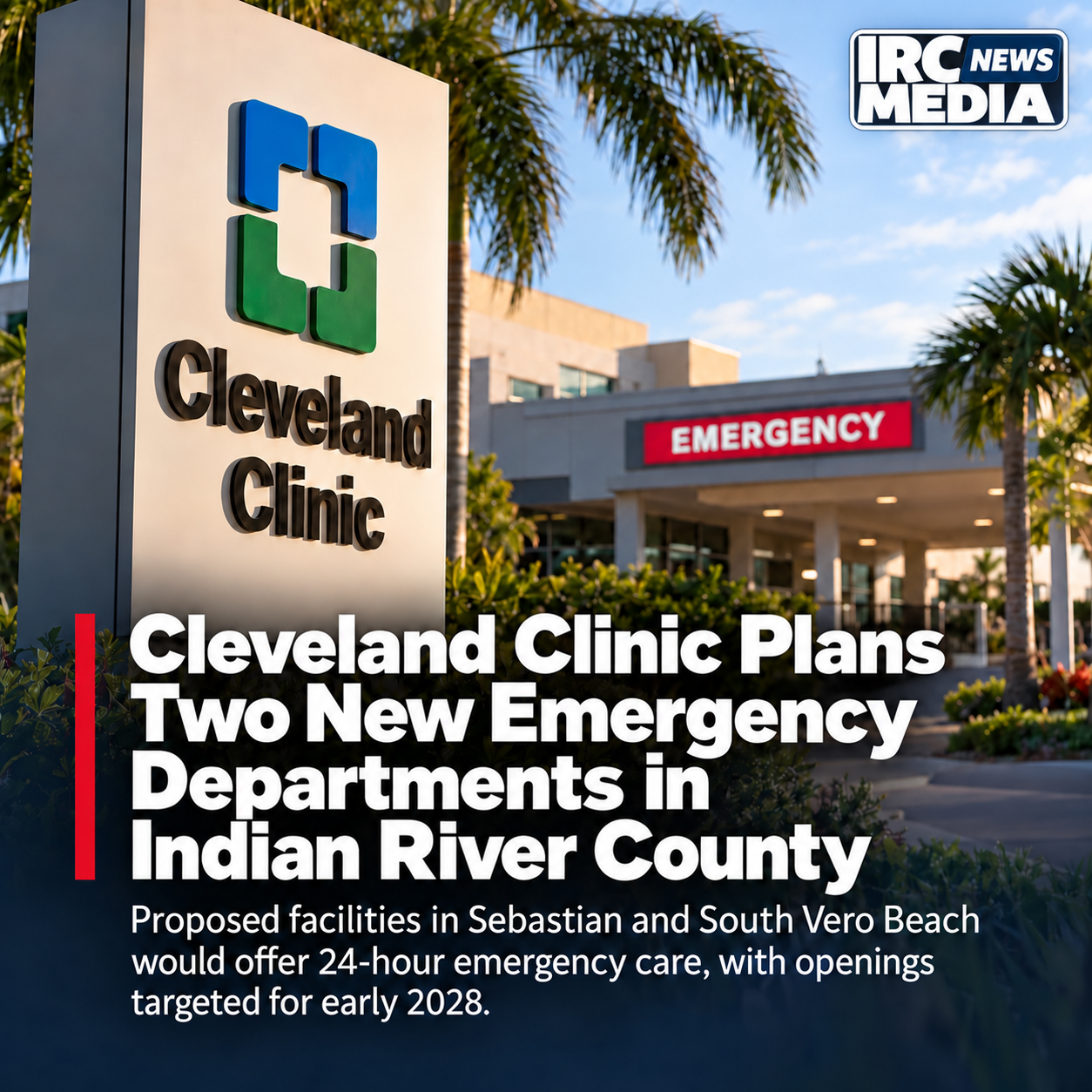
INDIAN RIVER COUNTY, Fla. — Indian River County could gain two additional places to receive around-the-clock emergency treatment even as leaders debate whether the county should make room for an entirely new hospital west of Vero Beach. Those parallel developments could reshape where residents seek care — and how much some may pay for it.
Cleveland Clinic is pursuing freestanding emergency departments in Sebastian and South Vero Beach, according to October 15 reporting by Vero News that included statements from Dr. Richard Rothman, vice president and chief medical officer of Cleveland Clinic Indian River Hospital. The reported goal is to open in early 2028. For now, that is a planning target, not an approved opening date, and neither proposal represents a new full-service hospital.
Two locations, both still in the planning stage
The proposed Sebastian site is on Sebastian Boulevard, also known as County Road 512, near South Wimbrow Drive. Vero News identified vacant land between the eastbound and westbound sections of the roadway, in the vicinity of 200 to 203 Sebastian Boulevard. The South Vero Beach location was identified as the southwest corner of Oslo Road and 27th Avenue Southwest, near an existing retail center.
The newspaper reported that developer Anchor Health Properties filed preliminary paperwork with Indian River County during August and September and that Cleveland Clinic had entered contracts to acquire property. Rothman said the land purchases had not yet closed when the plans became public. Those details establish an active proposal; they do not establish final development approval or permission to begin construction.
No verified final building size, bed or treatment-room count, capital budget, detailed equipment list, staffing plan or site-specific construction timetable has been made public for either location. IRC Media also has not independently confirmed final site approvals or an authorization to begin construction. The specific medical capabilities of each proposed department will become clearer only with completed plans and regulatory review.
An emergency department is not the same as a hospital
A freestanding emergency department is physically separate from a hospital campus but operates as a hospital emergency department. Florida’s Agency for Health Care Administration says hospital-based off-campus emergency departments must be under the same direction, offer the same emergency services and meet the same regulatory requirements as the hospital’s main emergency department.
That is different from an urgent care center, which generally treats non-life-threatening problems such as minor illnesses or injuries and is not intended to replace an emergency department for a stroke, heart attack or other potentially life-threatening condition. Emergency departments can evaluate and stabilize seriously ill or injured patients. The tests, imaging, specialist support and procedures available at a particular location depend on how it is equipped and staffed.
A freestanding ER ordinarily does not have the full complement of inpatient hospital beds, operating rooms and hospital services under the same roof. Patients who need admission, surgery or a higher level of specialty care may require transfer to a hospital. That can mean another ambulance trip, another handoff between medical teams and, depending on insurance and circumstances, additional charges. A nearby emergency department may shorten the first trip without eliminating a later transfer.
Rothman told Vero News the planned Sebastian department would accept both ambulance arrivals and walk-in patients and provide connections to specialty services at Cleveland Clinic Indian River Hospital when needed. A final transfer arrangement for each site, including how destinations would be selected, has not been independently documented.
The potential benefit: emergency care closer to home
For people in North County and the Oslo Road corridor, the appeal is straightforward. A facility closer to home could reduce the distance to an emergency medical evaluation, particularly when a family member is driving someone to seek treatment. Rothman described the project as part of a broader strategy to expand access to Cleveland Clinic care and improve follow-up with primary and specialty physicians.
He also told the newspaper that roughly one in five North Indian River County residents travels to Cleveland Clinic Indian River Hospital for emergency or specialty care. That figure is Cleveland Clinic’s stated assessment; IRC Media has not independently verified the underlying patient data.
An additional location does not automatically mean faster treatment for every patient. The outcome will depend on ambulance protocols, traffic, staffing, the number of patients arriving, the types of emergencies each site can handle and whether a hospital transfer is required. There are no verified local response-time projections for these projects that would justify promising a specific number of minutes saved.
Convenience may come with emergency-room prices
The distinction between an ER and urgent care is also a billing distinction. An off-campus hospital emergency department may generate hospital outpatient charges, including a facility component, along with separate professional and diagnostic charges. What an individual owes depends on the services delivered and the terms of the patient’s insurance.
Medicare explains that emergency department patients can owe a visit copayment, additional copayments for hospital services and a share of physician charges. For commercially insured patients, deductibles, copays and coinsurance may also apply. Federal protections generally limit unexpected out-of-network billing for covered emergency care, but they do not eliminate ordinary patient cost-sharing. Ground ambulance billing is a separate issue and may not receive the same federal protections.
No public price list or insurer-contract information specific to the proposed Sebastian and South Vero Beach departments was verified for this report. Residents should not assume that an ER closer to home will cost the same as an urgent care visit, or that treatment at an off-campus ER will necessarily cost less than care at the main hospital. For a true medical emergency, however, cost comparisons should not delay getting needed help.
New competition for existing hospitals
Cleveland Clinic Indian River Hospital remains the full-service hospital anchoring Cleveland Clinic’s local system. Orlando Health Sebastian River Hospital serves the northern part of the county. The proposed Sebastian ER would add a Cleveland Clinic emergency-care option relatively close to Orlando Health’s existing hospital emergency department, potentially giving some North County patients another provider choice.
Whether that competition produces shorter waits, improved access or higher costs cannot yet be determined. The projects could also affect recruiting for physicians, nurses, technologists and emergency personnel across the local healthcare workforce. Neither new-site staffing levels nor any projected effect on other facilities has been independently established.
A third hospital proposal is a different — and larger — decision
At the same time, a separate development group is exploring a new full-service hospital near State Road 60 and 66th Avenue, west of Vero Beach. The concept discussed with county commissioners calls for a roughly 250,000- to 260,000-square-foot, five-story hospital. Representatives have described a potential investment around $300 million, but that is a preliminary estimate for the separate hospital concept — not the cost of Cleveland Clinic’s two emergency departments.
The western proposal faces a significant land-use debate. A hospital of that height and size would require changes or exemptions under applicable county development restrictions. During an October 6 commission discussion, some officials questioned whether the need for a third hospital had been demonstrated and whether an exception could unintentionally affect future development elsewhere. Others said private hospital operators should judge market demand while the county focuses on land-use compliance.
WQCS reported that no vote was taken on October 6 and no formal hospital application had been submitted at that point. The developer would still have to navigate public hearings and state requirements. Unlike a freestanding ER, a full-service hospital could add inpatient capacity and a broader range of on-site services, depending on its ultimately approved design and operator.
The western hospital and Cleveland Clinic’s two ER projects are distinct proposals. The appearance of several healthcare plans at once does not prove that all three projects will be completed, or that each will satisfy the same community need.
What still needs answers before construction
For Cleveland Clinic’s plans, important unresolved questions include the final parcel boundaries; treatment-room counts; imaging, laboratory and specialty capabilities; construction and operating costs; staffing; ambulance and hospital-transfer agreements; participating insurance networks; expected patient charges; and the public status of development and state approvals.
Florida regulators require review of off-campus hospital emergency department building plans before construction, as well as a hospital application and compliance with safety and occupancy rules. Preliminary county discussions and a reported target opening in 2028 are not substitutes for those steps.
The central question for Indian River County families is not simply how many more medical buildings may appear on a map. It is whether patients will get appropriate care sooner, whether transfers will be coordinated safely, and whether the added convenience will be affordable. Until approvals, clinical plans and pricing become clearer, the two proposed ERs represent a potentially useful expansion — with meaningful questions still to answer.
IRC Media uses aggregated public data and verified sources; articles reviewed by editorial team to the best of our ability.