Local
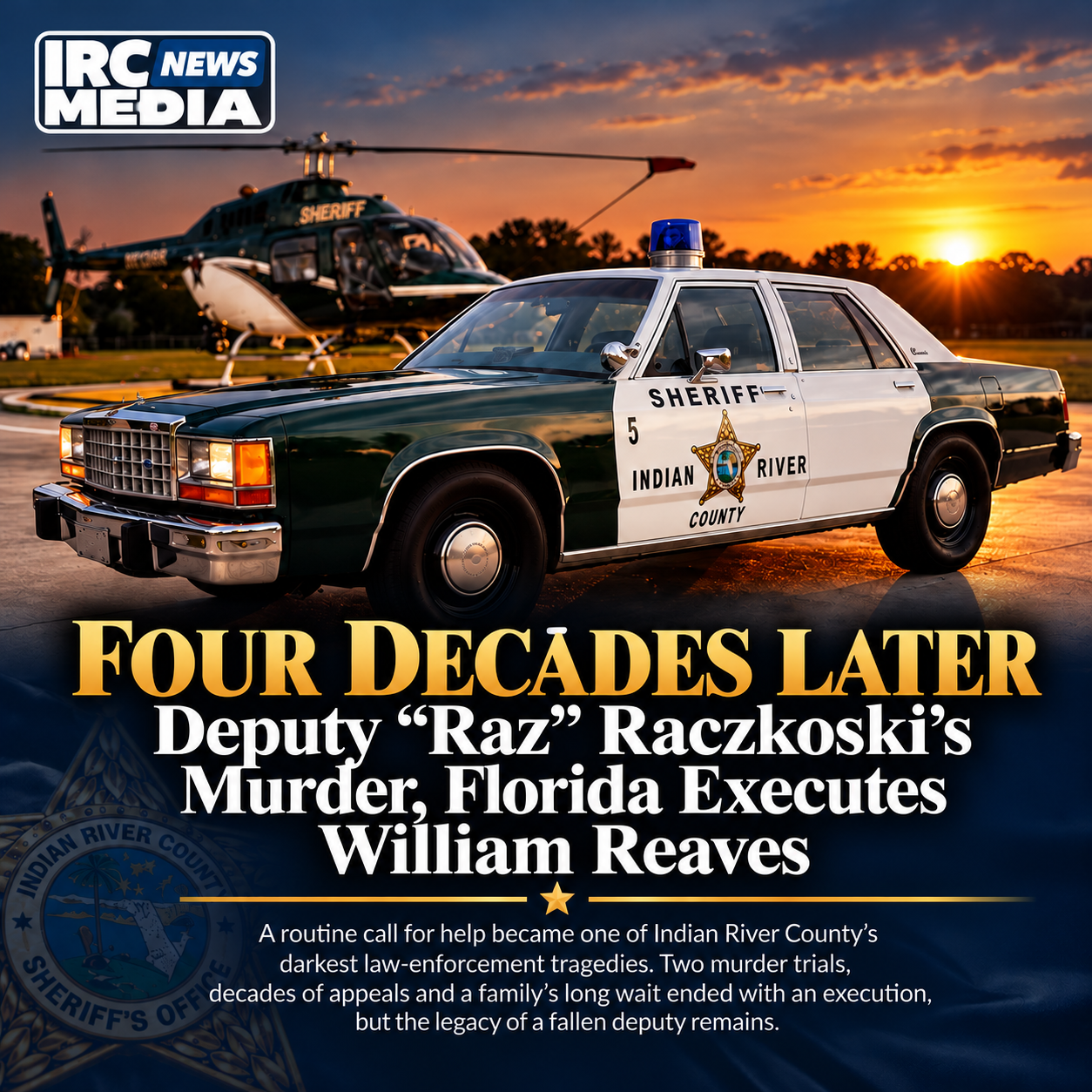
Four Decades After Deputy “Raz” Raczkoski’s Murder, Florida Executes William Reaves
A routine call for help became one of Indian River County’s darkest law-enforcement tragedies. Two murder trials, decades of appeals and a family's long wait ended with an execution, but the legacy of a fallen deputy remains.
Staff Writer
21 oct. 2026
VERO BEACH, Fla. — More than 40 years after an Indian River County sheriff’s deputy was shot and killed while responding to a call for help, Florida carried out the death sentence of the man convicted of his murder.
William Reaves Jr., 77, was pronounced dead at 6:12 p.m. Tuesday, October 20, 2026, following a lethal injection at Florida State Prison near Starke.
His execution marked Florida’s 18th of the year. But for Indian River County, it represented the final chapter of a case that began long before many of today’s residents were born.
On September 23, 1986, Deputy Richard Rudy “Raz” Raczkoski, just 29 years old, answered a 911 call at a convenience store west of Vero Beach. What began as an encounter with a man seeking transportation ended with the young deputy fatally wounded.
Raczkoski never returned home.
He left behind grieving parents, a younger brother, fellow officers and an unborn son who would grow up without ever meeting his father.
Four decades later, a restored 1986 sheriff’s patrol car honoring Raczkoski stood outside the prison where his convicted killer would be executed. Indian River County Sheriff Eric Flowers and Raczkoski’s brother, Marc, were among those present to witness the sentence carried out.
The execution brought an end to Reaves’ life and his lengthy legal battle. It could not return the years taken from the Raczkoski family.
A Call for Help on September 23, 1986
Shortly after 3 a.m., Deputy Raczkoski was dispatched to a Zippy Mart convenience store near State Road 60 and 82nd Avenue, west of Vero Beach.
According to Florida Supreme Court records, Reaves had used a pay telephone outside the store to call 911 because he did not have enough money to arrange a taxi.
Raczkoski responded to investigate the call. After speaking with Reaves, the deputy contacted the dispatcher to request a cab and checked for possible outstanding warrants.
The interaction might otherwise have ended with Reaves leaving in a taxi.
Instead, according to Reaves’ confession and testimony reviewed by the courts, a handgun fell from his shorts while the men were talking.
Raczkoski attempted to prevent Reaves from retrieving the weapon. A physical confrontation followed.
Reaves managed to regain possession of the gun and refused the deputy’s demand to surrender it.
The deputy backed away and turned to run.
Reaves fired repeatedly, striking Raczkoski four times in the back.
Court records established that Reaves emptied the seven-round ammunition supply from his .38-caliber handgun. Firearms testimony showed the weapon required a separate trigger pull for each shot.
Raczkoski collapsed near the convenience store and died later that morning.
During the investigation, Reaves acknowledged firing the shots. He claimed he had been using cocaine, panicked during the confrontation and feared being returned to prison.
Those statements became part of the evidence examined during the criminal proceedings, but they did not persuade the jury that the killing should escape a first-degree murder conviction.
The investigation also included testimony from Eugene Hinton, a friend whom Reaves visited after the shooting. Hinton testified that Reaves admitted shooting a police officer and described the confrontation.
Another witness who discovered Raczkoski outside the convenience store reported seeing a man matching Reaves’ description fleeing the scene.
Reaves left Indian River County and traveled north. Authorities arrested him in Albany, Georgia, approximately two days after the shooting.
While in custody in Georgia, he confessed to killing the deputy.
The murder triggered a criminal prosecution that would continue through state and federal courts for nearly four decades.
Who Was Richard “Raz” Raczkoski?
The story of Deputy Raczkoski is much larger than the circumstances of his death.
According to the Indian River County Sheriff’s Office memorial biography, Richard Rudy Raczkoski was born October 30, 1956, in Tampa to Rudy and Marion Raczkoski.
He grew up with a younger brother, Marc, and attended St. Anastasia Catholic School, John Carroll High School and Indian River Community College.
His interest in law enforcement developed partly through friendships with Florida Highway Patrol officers while he worked for the Florida Turnpike System in Fort Pierce.
Public service was also part of his family history. His maternal grandfather had served as a motorcycle police officer in New York.
Raczkoski began his law-enforcement career in January 1979 with the St. Lucie County Sheriff’s Office, where his assignments included jail corporal and auxiliary patrol duties.
He earned a commendation after pursuing and recapturing an escaped prisoner on foot.
In 1983, he joined the Indian River County Sheriff’s Office.
He continued seeking specialized training in criminal investigation, traffic enforcement, tactical driving and other areas of police work. According to the Sheriff’s Office, he was taking steps toward a future assignment in criminal investigations.
Outside law enforcement, Raz had interests that reflected an active life on Florida’s Treasure Coast.
He enjoyed motorcycles, working on vehicles, boating and fishing. He was a certified scuba diver and helped his father paint houses.
These details offer a picture of a young man with ambitions, family connections, personal interests and an unfinished future.
He had spent years developing a career. He was continuing his education. He was preparing for fatherhood.
His son, Matthew, was born after his death.
The murder did not simply end the life of a deputy responding to a call. It took a father from a child who had not yet been born and a brother from a family whose life would never return to what it had been.
The Family That Waited 40 Years
The passage of time became a defining part of the Raczkoski family's experience.
In a September 2026 interview with WPTV, Marc Raczkoski visited his brother’s grave at Hillcrest Memorial Gardens in Fort Pierce and recalled the night Richard was killed.
Marc described being taken to the hospital by a police officer who was also his brother’s friend. As he waited, he began to understand that Richard had not survived.
The effect on the family extended far beyond the funeral.
Marc recalled how his parents struggled with the loss, particularly during holidays.
“No more Christmas trees in the house. Holidays were never the same. Mom didn't decorate,” he told WPTV.
As the years passed, the legal proceedings continued.
Reaves remained on death row while Richard's family lived with the consequences of his murder. Raczkoski's parents died before the execution was carried out.
The deputy's son grew up without knowing his father, and Marc grew older while waiting for the criminal case to reach its conclusion.
By September 2026, when Gov. Ron DeSantis signed Reaves’ death warrant, the announcement represented something the family had awaited for most of Marc's adult life.
In his WPTV interview, Marc described the possibility of the execution as an opportunity for closure.
His comments conveyed not only relief but the enduring reality that the person whose death began the case could never be brought back.
The First Conviction — and a Reversal That Changed the Case
Reaves was convicted of premeditated first-degree murder in August 1987 and sentenced to death.
That verdict, however, did not survive appellate review.
In January 1991, the Florida Supreme Court overturned his conviction after finding a serious conflict of interest involving the prosecution.
Bruce Colton, a prosecutor involved in the murder case, had previously represented Reaves while working as an assistant public defender in an unrelated criminal matter.
The Supreme Court concluded that the conflict required disqualification and that the failure to remove Colton from the prosecution necessitated a new trial.
The ruling was not a determination that Reaves was innocent. It addressed the fairness and integrity of the criminal proceedings.
In February 1992, Reaves stood trial again.
A second jury convicted him of first-degree premeditated murder and recommended the death penalty by a vote of 10 to 2. The court imposed another death sentence.
In 1994, the Florida Supreme Court upheld the new conviction and sentence.
The justices did reject one of the sentencing court’s findings: that the murder met the especially heinous, atrocious or cruel aggravating circumstance under Florida capital-sentencing law.
But the court concluded that the error did not require a new sentence because other aggravating circumstances remained.
Those included Reaves’ prior violent felony history and the finding that the murder was committed to avoid or prevent lawful arrest.
The conviction and death sentence remained in place.
Decades of Appeals and Unanswered Legal Questions
The 1994 decision was far from the end of the litigation.
Over the following decades, Reaves pursued numerous appeals and postconviction motions challenging both his conviction and his death sentence.
His attorneys argued, among other things, that earlier defense counsel had failed to adequately investigate or present evidence concerning his drug use, mental health and experiences in the Vietnam War.
A major issue involved whether Reaves had been so impaired by substance use and psychological conditions that his attorney should have pursued a voluntary-intoxication defense during the guilt phase of the trial.
In 2002, the Florida Supreme Court ordered an evidentiary hearing on that limited ineffective-assistance claim.
After additional proceedings, the state courts rejected the argument. The Florida Supreme Court affirmed the denial of relief in 2006.
Federal litigation continued.
In 2013, the U.S. Court of Appeals for the Eleventh Circuit overturned a federal district court ruling that had granted Reaves relief based on his attorney's failure to pursue a voluntary-intoxication defense.
Additional proceedings over sentencing-stage representation followed.
In 2017, the Eleventh Circuit reversed another federal ruling granting relief, concluding that the applicable standards for reviewing the state court’s decision had not been satisfied.
The litigation illustrated how complicated capital cases can become when courts must evaluate trial errors, constitutional protections, mental-health evidence and the limits of reviewing earlier decisions.
Another significant challenge emerged following the U.S. Supreme Court’s 2016 decision in Hurst v. Florida, which held that Florida’s former capital-sentencing procedure violated constitutional jury-trial requirements.
Reaves sought relief under that decision.
In May 2018, the Florida Supreme Court rejected his request for a new sentencing proceeding, holding that the Hurst ruling did not apply retroactively to his death sentence, which had become final in 1994.
Each proceeding added another chapter to the legal history of the case.
For the state, the conviction remained legally valid. For the defense, questions about the fairness of the proceedings continued to form the basis for new challenges.
For Raczkoski's family, the passage of time was measured in years without their loved one.
Vietnam Service, PTSD and the Evidence the Jury Heard
Reaves’ military service and mental health became some of the most contested aspects of the prolonged appeals.
He served in the U.S. Army during the Vietnam War and received an honorable discharge.
A psychologist who evaluated him for the defense diagnosed several conditions, including substance-abuse problems, antisocial personality disorder and what was described as “Vietnam Syndrome,” a condition characterized as a subclinical form of post-traumatic stress disorder.
The defense presented evidence involving his military background and psychological difficulties.
Years later, the U.S. Department of Veterans Affairs determined that Reaves was 100% disabled because of service-related PTSD.
That determination, made in 2003, came more than a decade after his second murder trial.
Reaves' attorneys argued that the sentencing jury had not received the full picture of the psychological injuries associated with his wartime experiences and how those conditions might have affected his conduct.
The distinction is important: the jury did hear some evidence about Reaves’ military service and psychological difficulties, but it did not hear the later VA disability determination or the full body of evidence developed in subsequent litigation.
The courts ultimately concluded that the additional evidence did not establish a legal basis to overturn his sentence.
The 2017 federal appellate decision emphasized that the defense had presented mental-health-related evidence and that the state court had reasonably rejected claims that additional testimony would have changed the outcome.
As the October 2026 execution approached, more than 100 military veterans appealed to Gov. DeSantis to intervene.
Their request for clemency focused on Reaves’ combat-related psychological injuries and whether those circumstances had been adequately considered.
Death-penalty opponents argued that the state's responsibility to recognize military-related mental illness remained significant even in a case involving an admitted murder.
Those arguments did not erase the crime or the suffering it caused.
They raised a separate legal and ethical question: whether a sentence imposed decades earlier had adequately accounted for all relevant mitigating evidence.
The courts repeatedly examined challenges to the sentence and ultimately allowed it to stand.
The Final Legal Battle
On September 18, 2026, Gov. Ron DeSantis signed a death warrant scheduling Reaves’ execution for October 20 at 6 p.m.
The decision brought renewed attention to a case that IRC Media had reported on when the warrant was signed.
IRC Media's September coverage of the death warrant detailed the murder, earlier convictions and Sheriff Flowers' longstanding calls for the sentence to be carried out.
In the weeks that followed, Reaves’ attorneys pursued additional legal challenges.
They raised objections involving the clemency process, access to relevant records, the effectiveness of representation during clemency proceedings, and Florida’s three-drug lethal-injection procedure.
His hearing difficulties and concerns about the execution protocol also became part of the litigation.
On October 14, the Florida Supreme Court rejected his latest challenges and refused to stay the execution.
The court found that the clemency claims did not warrant relief and that the method-of-execution challenge was procedurally barred, untimely and unsuccessful under existing precedent.
Reaves then sought intervention from the U.S. Supreme Court.
On October 20, the nation's highest court denied his application for a stay and refused to hear the case.
The execution proceeded that evening.
October 20, 2026: The Sentence Is Carried Out
At Florida State Prison, witnesses gathered for an execution that had been scheduled for 6 p.m.
Reaves was secured to a gurney when the death chamber curtain opened.
According to the Associated Press, he was asked whether he wished to make a final statement.
“No, I do not,” he replied.
The three-drug lethal-injection procedure then began.
Reaves was pronounced dead at 6:12 p.m.
Sheriff Eric Flowers witnessed the execution, as did Richard Raczkoski’s younger brother, Marc.
Flowers later explained that he had deliberately positioned himself where Reaves could see his Indian River County Sheriff's Office uniform.
The sheriff had publicly advocated for the execution and described it as an important moment for the agency and the family.
Following the procedure, he expressed frustration that Reaves had not offered an apology or a final statement to those affected by the murder.
At the same time, Flowers drew a distinction between the sentence being carried out and the concept of justice itself.
Speaking to reporters, he described the event as closure rather than justice, noting the contrast between Reaves’ death at age 77 and the violent death Raczkoski suffered at 29.
For Marc Raczkoski, the moment carried a different, intensely personal significance.
After witnessing the execution, he told reporters that Richard finally had justice and that the matter had been put to rest.
The two responses reflected different ways of understanding the same event.
Neither could change what happened outside the Zippy Mart in September 1986.
The Deputy Who Remains Part of Indian River County's History
Long before Reaves’ execution, Deputy Raczkoski's sacrifice had become part of Indian River County's law-enforcement history.
The Sheriff’s Office has continued to recognize him through its memorial records, ceremonial observances and public tributes.
A stretch of State Road 60 between Interstate 95 and 43rd Avenue carries the designation Richard Raczkoski Memorial Highway.
The recognition places his name along one of Indian River County’s principal roadways, near the area where he lost his life.
On May 3, 1987, Raczkoski was posthumously awarded the Medal of Valor by the International Police Association in recognition of his service and bravery.
Decades later, the Sheriff’s Office developed another tribute that connected his memory with the era in which he served.
In March 2024, a restored 1986 Ford Crown Victoria patrol car was dedicated in Raczkoski's honor.
The vehicle was styled to represent the Sheriff’s Office patrol cars of his time.
Rather than existing only as a museum-style display, the tribute vehicle has appeared at public events, helping introduce a new generation of Indian River County residents to the story of the fallen deputy.
On October 20, 2026, the restored car traveled to Florida State Prison ahead of Reaves’ execution.
Its presence served as a reminder that the events of September 1986 were not simply entries in a criminal case file.
They remained part of the identity and memory of an entire law-enforcement agency.
Raczkoski was also honored during National Police Week observances at the Indian River County Courthouse, including a ceremony in May 2026.
His memory now carries an additional connection to a more recent tragedy.
On November 21, 2025, Sheriff’s Sgt. Terri Sweeting-Mashkow was fatally shot while serving an eviction notice in Indian River County, becoming the agency's second deputy to die in the line of duty.
Her death brought another period of mourning to the department and renewed public attention to the risks deputies face while carrying out their responsibilities.
Following Reaves’ execution, Flowers said the Sheriff’s Office expected to unveil a monument in November honoring both fallen deputies.
The two tragedies occurred nearly four decades apart, but both left lasting effects on families, fellow officers and the community.
Justice, Accountability and the Passage of Time
The Reaves case raises difficult questions that extend beyond Indian River County.
Forty years is an extraordinary amount of time between a murder and the execution of the person convicted of committing it.
Some of that delay resulted from the original conviction being overturned because of a constitutional concern involving the prosecution.
Other years were consumed by challenges to the effectiveness of defense representation, the consideration of mental-health evidence, changes in death-penalty law and the procedures governing executions.
Supporters of capital punishment argue that carrying out a lawful sentence fulfills a commitment to accountability and to victims whose families may otherwise spend decades waiting for a final resolution.
Critics argue that the death penalty's irreversible nature demands extensive review, particularly when questions arise concerning mental illness, the effectiveness of counsel or constitutional protections.
These positions reflect enduring disagreements about the purpose and administration of capital punishment.
Reaves' guilt was established through a retrial and sustained through years of appellate review. The existence of legal disputes does not change the judicial findings concerning Raczkoski's murder.
At the same time, the length and complexity of the proceedings demonstrate why capital cases receive extensive scrutiny.
The courts must protect constitutional rights while also considering the state's interest in enforcing lawful judgments.
For victims’ families, those legal principles can coexist with a deeply personal reality: the person they lost remains absent regardless of the final sentence.
Marc Raczkoski’s comments following the execution established how he understood that evening. Sheriff Flowers described his own understanding differently.
Neither perspective should be expanded into a claim about what every surviving family member or law-enforcement officer feels.
Remembering the Man Behind the Badge
October 20, 2026, will remain an important date in Florida's capital-punishment history.
It was the day William Reaves was executed for a murder committed more than four decades earlier.
But September 23, 1986, remains the more consequential date in the life of the Raczkoski family and the history of the Indian River County Sheriff’s Office.
That was the morning a 29-year-old deputy answered a call from someone who needed assistance.
The encounter became violent, and a young officer lost his life.
Richard Rudy “Raz” Raczkoski would never finish his career, enter the criminal investigations work he had been pursuing or meet the son born after his death.
His parents would spend the rest of their lives without him. His brother would carry memories of their shared childhood into middle age and beyond.
For generations of Indian River County deputies, his name has represented one of the most serious sacrifices a law-enforcement officer can make.
The restored patrol car, the highway bearing his name and the continued remembrance of his service ensure that his story remains visible.
The legal case has ended. The family's loss cannot be undone.
Richard “Raz” Raczkoski's legacy, however, extends beyond the manner of his death. It rests in the service he gave, the future he was building and the determination of his community to remember the deputy who answered a call for help and never returned home.
Advertisement
IRC Media uses aggregated public data and verified sources; articles reviewed by editorial team to the best of our ability.