News
Trump Announces $15 Billion Iowa Steel Project as U.S. Pushes to Rebuild Domestic Industrial Supply Chain
New steel mill would connect Minnesota iron ore production with millions of tons of new U.S. steelmaking capacity
Staff Writer
28 sept. 2026
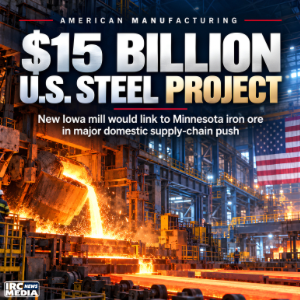
President Donald Trump announced Monday a planned $15 billion steel project in Iowa, a massive industrial investment that would tie a newly opened Minnesota iron-ore operation to a new generation of domestic steel production.
The project is being developed by Mesabi Metallics and is expected to initially produce approximately 7.5 million tons of steel annually, with plans that could ultimately increase capacity to roughly 10 million tons per year. Production is targeted to begin around 2030. Reuters reported that the project is expected to create approximately 6,000 construction jobs and 1,750 permanent jobs.
The White House is promoting the project as part of the administration’s effort to expand U.S. manufacturing and reduce reliance on foreign industrial supply chains.
But the significance of the announcement goes beyond a single steel mill.
Source: @NickSortor on X
From Minnesota Iron Ore To Iowa Steel
Mesabi Metallics has recently begun startup operations at its iron-ore mine and pellet plant near Nashwauk, Minnesota — a project the U.S. Export-Import Bank describes as the first new iron-ore mine and pellet facility to begin operations in the United States in approximately 50 years.
The Minnesota operation represents an investment of more than $2.5 billion and is expected to produce as much as 7 million tons per year of high-grade direct-reduction iron-ore pellets.
Those pellets are designed for use in modern steelmaking operations, including electric-arc-furnace production.
According to EXIM, much of that type of high-grade material is currently imported into the United States.
That makes the combination of the Minnesota mine and the proposed Iowa mill particularly notable: instead of importing the raw material and potentially the finished steel, the company is attempting to establish a larger domestic production chain stretching from the mine to the finished product.
Thousands Of Jobs
The Iowa development would rank among the largest announced manufacturing investments in the country.
Reuters reported that the project is expected to generate roughly 6,000 construction jobs during development and approximately 1,750 permanent positions once operating.
In Minnesota, Mesabi Metallics currently employs more than 200 people and expects to add approximately 350 additional permanent workers once its mine and pellet operation reaches full production. EXIM also reported that more than 1,500 construction contractors were working at the Minnesota site as startup operations began.
Taken together, the projects represent an unusually large expansion of the domestic iron-and-steel supply chain.
Federal Financing Plays A Major Role
The federal government is also deeply involved in the Minnesota side of the project.
EXIM announced that it is supporting up to $10 billion in financing for expansion of Mesabi Metallics' operations in Minnesota.
Federal records show the Mesabi iron mine and direct-reduction pellet plant came before EXIM's board in September for final-approval consideration.
That means the broader project is not solely a private-sector investment story. It is also part of a federal strategy using financing, trade policy and industrial policy to encourage production of materials considered important to the U.S. manufacturing base.
EXIM Chairman John Jovanovic described the issue in national-security terms during a September visit to the Minnesota operation, saying supply-chain security and domestic production were closely connected.
Tariffs Are Part Of The Equation
The announcement also comes against the backdrop of the Trump administration's aggressive use of tariffs on imported metals.
In April, Trump imposed a 50 percent tariff on many imported steel, aluminum and copper products, with different rates and exceptions applying to certain derivative products and trading partners. The administration has argued that the measures are intended to protect domestic production capacity and national security.
The White House has pointed to new manufacturing projects and rising domestic steel capacity as evidence that the tariff strategy is encouraging companies to invest inside the United States.
Whether tariffs alone are responsible for individual investments is more difficult to establish. Large industrial projects are influenced by numerous factors, including energy costs, access to raw materials, financing, transportation infrastructure, labor costs and long-term steel demand.
The Iowa announcement nevertheless gives the administration a major example to point toward as it argues that trade barriers and federal industrial policy can encourage additional American production.
Why High-Grade Iron Ore Matters
One of the less visible parts of the story may ultimately be among the most important.
The Minnesota facility is designed to produce direct-reduction-grade pellets, a higher-quality iron product used in increasingly modern steelmaking systems.
Mesabi Metallics says its operation is positioned to reduce U.S. dependence on foreign sources of that material, including supplies traditionally imported from countries such as Brazil.
For policymakers concerned about industrial independence, that distinction matters.
Building a steel mill inside the United States provides domestic manufacturing capacity. Producing more of the raw materials required to operate that mill domestically creates a more complete supply chain.
That is why the Minnesota and Iowa projects are best understood together.
An American Project With International Ownership
There is also an important distinction in describing Mesabi Metallics as part of a domestic manufacturing expansion.
The mining and proposed steel production would occur inside the United States and employ American workers, but Mesabi Metallics is backed by Essar Group, an international conglomerate with roots in India. Public filings describe Mesabi Metallics as part of the Essar group of companies.
Foreign-owned companies investing in U.S. manufacturing is not unusual, but the distinction is worth noting when discussing the project's role in “American” manufacturing.
In this case, the domestic component centers on where the ore is mined, where steel would be produced, where workers would be employed and where the industrial infrastructure would be located.
A Potentially Enormous Addition To U.S. Steel Capacity
The proposed output is what makes the Iowa project stand out.
At an initial 7.5 million tons per year, the facility would represent a major addition to U.S. steelmaking capacity. An eventual expansion toward 10 million tons annually would make the project larger still.
Trump and the White House have characterized the project as the largest steel-plant investment in U.S. history. Because industrial projects can be measured differently — by investment value, capacity, physical size or production — IRC Media is treating that characterization as an administration claim while focusing on the independently reported project figures.
Those figures alone establish the scale.
The Bigger Picture
For decades, debates over American manufacturing have often focused on factory closures, overseas production and dependence on foreign suppliers.
The Mesabi projects represent an attempt to move in the opposite direction.
Iron ore would be mined and processed in Minnesota. High-grade pellets would supply domestic steel production. A new Iowa mill would convert that material into millions of tons of steel each year.
The project would be supported by billions of dollars in private investment alongside potentially substantial federal financing, while operating within a trade environment designed to make imported steel more expensive.
Whether the project ultimately reaches all of its announced production and employment goals will depend on construction, financing, market conditions and execution over the next several years.
But if completed at the announced scale, the Minnesota-to-Iowa operation would represent one of the most significant expansions of the American steel supply chain in decades — and a major test of the administration's broader effort to rebuild domestic industrial capacity.
IRC Media uses aggregated public data and verified sources; articles reviewed by editorial team to the best of our ability.
