Local
Vero Beach Airport Takes Another Leap: Four New Breeze Routes Push VRB to 11 Nonstop Destinations
Atlantic City joined Vero Beach Regional Airport’s growing route map Friday, following new service to Trenton, Baltimore and Pittsburgh as passenger traffic and airport infrastructure continue to expand.
Staff Writer
3 oct. 2026
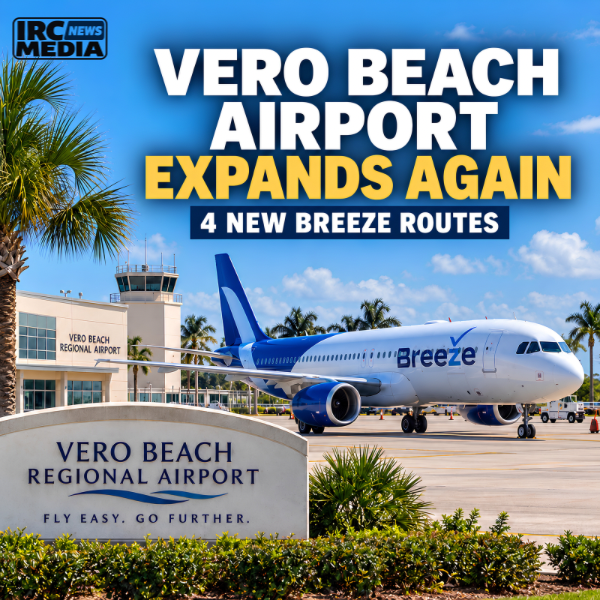
VERO BEACH, Fla. — What began three years ago as a relatively small return of scheduled jet service to Vero Beach has developed into a much larger commercial-airline operation.
Breeze Airways completed its latest expansion at Vero Beach Regional Airport on Friday, Oct. 2, with the launch of nonstop service to Atlantic City International Airport. That followed new flights to Trenton-Mercer Airport on Sept. 30 and new service to Baltimore/Washington International and Pittsburgh International on Oct. 1.
The four new routes bring Breeze’s verified nonstop network from Vero Beach to 11 destinations: White Plains, Long Island/Islip, Providence, Hartford, New Haven, Washington Dulles, Raleigh-Durham, Trenton, Baltimore, Pittsburgh and Atlantic City.
For residents of Vero Beach, Sebastian, Fellsmere and the rest of Indian River County, the significance is larger than four additional dots on an airline route map. Vero Beach Regional Airport is moving from a small airport with limited scheduled service toward a busier regional commercial airport with multiple airlines, a growing passenger base and increasingly complex infrastructure needs.
FOUR NEW ROUTES IN THREE DAYS
The newest round of Breeze expansion began Wednesday, Sept. 30, with service to Trenton, New Jersey.
On Thursday, Oct. 1, Breeze added Baltimore/Washington International Thurgood Marshall Airport and Pittsburgh International Airport.
Then on Friday, Oct. 2, Atlantic City International Airport joined the network. Breeze’s own booking site showed the first VRB-Atlantic City departure for Oct. 2, and flight-tracking data confirms that inaugural flight operated.
Those launches are not merely future announcements. As of Saturday, Oct. 3, all four start dates have arrived.
Breeze’s published schedules show that these routes operate on limited weekly frequencies rather than daily service, and schedules can change by season. Travelers should verify their exact travel dates before booking.
WHERE CAN YOU FLY NONSTOP FROM VERO BEACH?
Breeze currently markets nonstop service from Vero Beach to:
• White Plains, New York — Westchester County Airport (HPN) • Long Island/Islip, New York — Long Island MacArthur Airport (ISP) • Providence, Rhode Island — Rhode Island T.F. Green International Airport (PVD) • Hartford, Connecticut — Bradley International Airport (BDL) • New Haven, Connecticut — Tweed New Haven Airport (HVN) • Washington, D.C. area — Washington Dulles International Airport (IAD) • Raleigh-Durham, North Carolina — Raleigh-Durham International Airport (RDU) • Trenton, New Jersey — Trenton-Mercer Airport (TTN) • Baltimore, Maryland — Baltimore/Washington International Thurgood Marshall Airport (BWI) • Pittsburgh, Pennsylvania — Pittsburgh International Airport (PIT) • Atlantic City, New Jersey — Atlantic City International Airport (ACY)
Breeze also markets some one-stop, no-change-of-plane itineraries from Vero Beach. Those should not be confused with nonstop routes and are not included in the 11-destination nonstop count.
THE GROWTH SINCE BREEZE ARRIVED
Breeze began Vero Beach service in February 2023.
City airport records show the airline carried 85,728 arriving and departing passengers in 2023. That total more than doubled to 175,995 in 2024.
By 2025, with additional airline service entering the market, Vero Beach Regional Airport recorded 259,040 total airline passengers across all carriers. That city figure counts both arriving and departing passengers.
That distinction matters because total passengers are not the same as FAA enplanements. An enplanement is a passenger boarding an aircraft for departure.
The FAA’s final 2024 data counted 88,608 enplanements at VRB, compared with 42,329 in 2023 — an increase of 109.33 percent. That placed Vero Beach in the FAA’s primary, nonhub commercial-service category.
The city’s 2026 monthly figures showed the momentum continuing. January recorded 28,653 total passengers, February 32,026 and March 43,760. Those first three months totaled 104,439 arriving and departing passengers, compared with 79,741 during the same three months of 2025.
IT IS NO LONGER JUST BREEZE
Breeze remains the airline with the largest route network at Vero Beach, but the airport is no longer a one-airline operation.
JetBlue began Vero Beach service in December 2025 and continues service to Boston. American Airlines began service to Charlotte in February 2026 and has also announced seasonal Saturday nonstop service to Philadelphia beginning Nov. 7, 2026.
That means the broader VRB route map extends beyond Breeze and now gives Treasure Coast travelers access to both point-to-point leisure routes and a major connecting hub through Charlotte.
A SMALL TERMINAL HANDLING MUCH BIGGER NUMBERS
Passenger growth has forced physical changes at an airport terminal originally built for a very different level of activity.
City airport records show a terminal renovation project that includes covered passenger walkways, a covered baggage-claim area, restroom improvements and other upgrades. Airport officials have also been working on parking expansion, rental-car facilities, taxiway improvements and airfield electrical projects.
The airport has also had to prepare for higher Aircraft Rescue and Firefighting requirements as the number and size of scheduled airline operations increase. In practical terms, that means more airline activity can require additional firefighting equipment and staffing capacity to meet federal safety standards.
Airport officials have discussed adding roughly 9,000 square feet to the terminal and are using the airport master-planning process to guide future development.
THE PASSENGER THRESHOLD THAT MATTERS
VRB has already crossed one important federal benchmark.
Airports with more than 10,000 annual passenger boardings are treated as primary commercial-service airports. With 88,608 FAA-recorded enplanements in 2024, Vero Beach was already well above that threshold.
Airport officials have also focused on the 100,000-enplanement level because it can affect Florida Department of Transportation funding formulas. In January 2025, airport officials reported that Breeze alone had 88,525 departing passengers in 2024 and noted that crossing 100,000 annual enplanements could change the state funding mix available to the airport.
In plain English, passenger growth can improve the airport’s case for larger capital projects and alter the funding formulas available to support them. It also increases pressure on parking, terminal capacity, baggage handling, security coordination, emergency response and ground transportation.
WHAT THE EXPANSION MEANS FOR TREASURE COAST TRAVELERS
For years, Indian River County travelers looking for a broad selection of nonstop flights often drove to Orlando International, Palm Beach International, Fort Lauderdale-Hollywood International or Melbourne Orlando International.
VRB still cannot match those airports for daily frequency or nationwide connectivity, and many Breeze routes operate only a few days each week. But the local-airport equation is changing.
A nonstop flight from Vero Beach can eliminate a lengthy drive before the airport experience even begins. The airport also continues to offer free long-term parking, although travelers should review current airport parking rules before leaving a vehicle for an extended period.
For Sebastian and northern Indian River County residents, VRB still requires a drive, but it can be considerably closer than Palm Beach or Orlando. For many Vero Beach residents, the terminal is only minutes away.
The tradeoff is schedule flexibility. A route operating two or three times per week may work extremely well for a vacation, family visit or second-home trip, but not for every business traveler or last-minute itinerary.
That is why the sustained passenger demand behind the new routes will matter as much as the destination count itself.
ECONOMIC AND TOURISM IMPACT
Additional nonstop service works in both directions.
It gives Indian River County residents more travel options, but it also makes Vero Beach and the Treasure Coast easier to reach from the Northeast, Mid-Atlantic and other markets without a connection or a long drive from another Florida airport.
That can benefit hotels, vacation rentals, restaurants, car-rental companies and local attractions while also making the region more accessible to seasonal residents, families and business travelers.
Commercial aviation is expanding alongside one of Florida’s busiest general-aviation environments. The airport supports flight training, corporate aviation and Piper Aircraft manufacturing in addition to scheduled passenger service, which means growth must be managed across several different types of airport activity.
WHAT’S NEXT FOR VRB?
The next phase will be as much about capacity as destinations.
The airport’s capital program includes parking expansion, taxiway work, airfield electrical improvements and terminal-related projects. City officials have also discussed additional terminal space as passenger demand grows.
The airport is now coordinating scheduled operations among Breeze, JetBlue and American — a level of activity that did not exist when Breeze first arrived in early 2023.
The latest Breeze additions make the question less about whether commercial service can work in Vero Beach and more about how much service the airport and the Treasure Coast market can support.
Three years after Breeze’s arrival, Vero Beach Regional Airport has become a meaningful part of the region’s transportation system. The Atlantic City flight that launched Friday is the newest sign of that shift.
For Treasure Coast travelers, VRB remains smaller and less frequent than South Florida or Orlando’s major hubs. But with 11 Breeze nonstops, three scheduled airlines, rapidly rising passenger totals and multiple infrastructure projects underway or planned, the airport is no longer a minor commercial experiment.
It is becoming a regional travel option that more Indian River County residents will have reason to check before making the drive elsewhere.
Advertisement