World
Welcome, October: Why the “Eighth Month” Is Now the Tenth
The story behind October’s ancient Roman name, Florida’s version of fall and the history packed into the month.
Staff Writer
1 oct. 2026
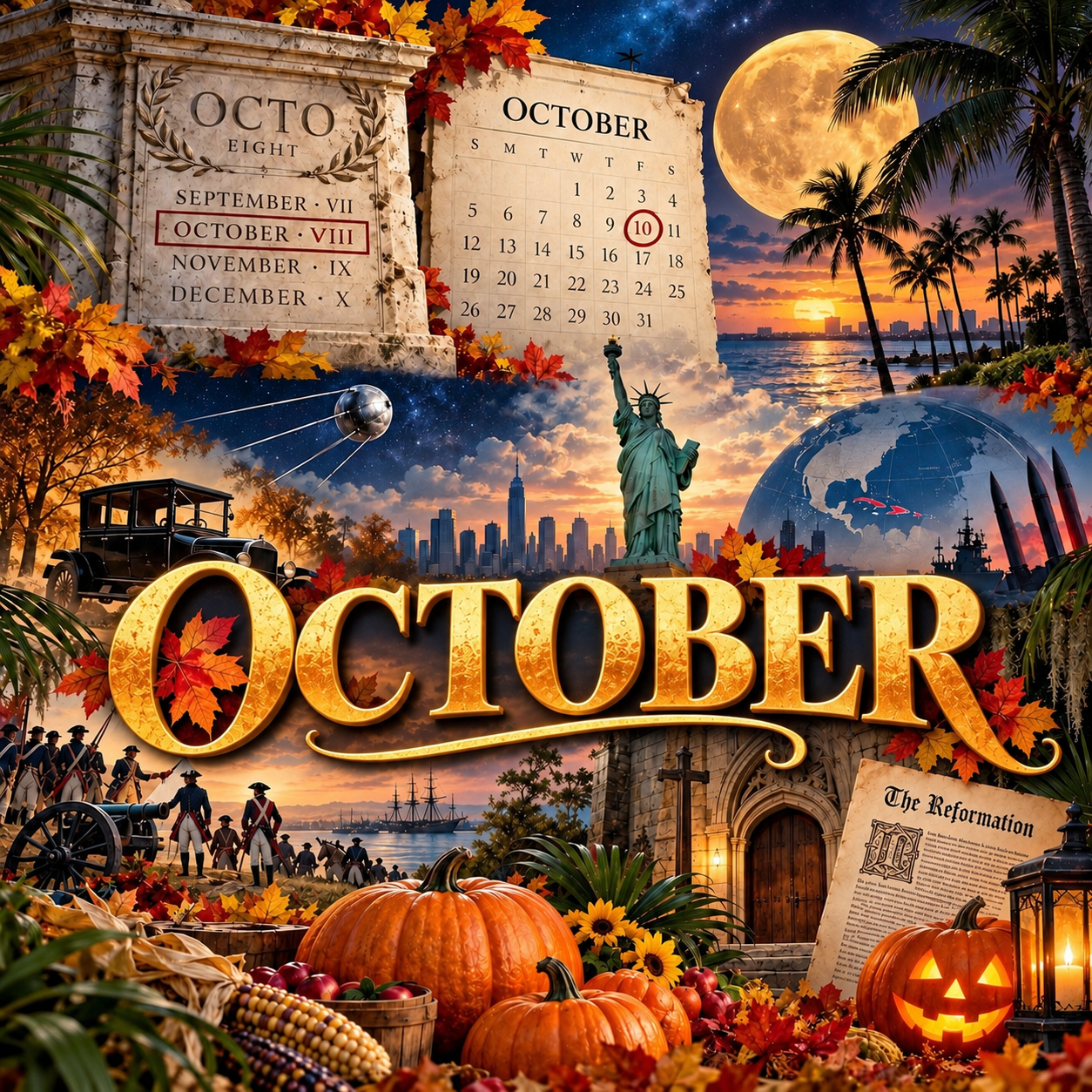
October has arrived, bringing with it the beginning of a new stretch of the fall season — cooler mornings, earlier sunsets, pumpkins, festivals, football and, eventually, a little relief from Florida’s summer heat.
But October carries something else with it: a name that is more than 2,000 years old and no longer matches its place on the calendar.
October literally means “eighth.”
The name comes from the Latin word octo, meaning eight. Yet October is, of course, the 10th month of the year.
So how did the eighth month become the tenth?
A Name Left Over From Ancient Rome
The answer goes back to the early Roman calendar.
According to the traditional account of Rome’s calendar, the year once began in March, rather than January. That made March the first month of the year.
Count forward from there and the old names begin to make sense:
March was first, April second, May third and June fourth.
Then came the months whose names reflected their numerical positions: September from septem, meaning seven; October from octo, meaning eight; November from novem, meaning nine; and December from decem, meaning ten.
January and February eventually became part of the calendar system ahead of March, and January later became recognized as the beginning of the civil year.
October was pushed from the eighth position to the 10th.
Its name, however, never changed.
The same is true for September, November and December. Their names remain linguistic fossils from an ancient calendar in which they occupied different positions.
Every time we say “October,” then, we are repeating a small piece of Roman history.
Fall Arrives — Florida Style
For much of the country, October means brilliant red and gold leaves, falling temperatures and the unmistakable arrival of autumn.
Florida has its own version.
Along the Treasure and Space Coasts, the palms remain green, afternoons can still feel plenty warm and shorts may remain part of the wardrobe well into the season.
But there are changes.
The days grow shorter. Humidity gradually begins to ease. Community festivals and outdoor events become more comfortable, and eventually those first cooler mornings arrive that remind Floridians why this is one of the most anticipated times of the year.
October is also still part of Atlantic hurricane season, which runs through November 30, so fall's arrival does not mean Florida can completely stop watching the tropics.
October Has Seen Plenty of History
The month has also been the backdrop for events that changed transportation, warfare, science, government and culture.
On October 1, 1908, Ford introduced the Model T. The automobile would become one of the most influential vehicles in American history, helping make personal transportation available to millions of Americans.
On October 4, 1957, the Soviet Union launched Sputnik 1, the first artificial satellite to orbit Earth. Its launch marked the beginning of the Space Age and intensified the competition between the United States and Soviet Union that became known as the Space Race.
On October 14, 1947, American test pilot Chuck Yeager became the first person confirmed to exceed the speed of sound in level flight.
October also contains one of the most important anniversaries of the American Revolution.
On October 19, 1781, British forces under Gen. Charles Cornwallis surrendered at Yorktown, Virginia. Major fighting in the Revolutionary War largely came to an end, clearing the way for recognition of American independence.
Then came one of the most dangerous Octobers in modern history.
In October 1962, the discovery of Soviet nuclear missiles in Cuba triggered the Cuban Missile Crisis. For nearly two weeks, the United States and Soviet Union confronted one another in a standoff that brought the world extraordinarily close to nuclear war.
On October 24, 1945, the United Nations officially came into existence following the devastation of World War II.
On October 28, 1886, the Statue of Liberty was dedicated in New York Harbor, eventually becoming one of the most recognizable symbols of the United States.
And on October 29, 1929, Wall Street suffered Black Tuesday, one of the defining moments of the stock market collapse associated with the beginning of the Great Depression.
Halloween — And Another October 31 Anniversary
October ends with its most recognizable celebration: Halloween.
Modern Halloween developed through a mixture of ancient seasonal customs, Christian observances and centuries of European and American traditions. Today, October 31 is synonymous with pumpkins, costumes, haunted houses and trick-or-treating.
But the date carries another major historical association.
Many Christians observe October 31 as Reformation Day, commemorating the traditional date in 1517 when Martin Luther is said to have presented his Ninety-five Theses, an event closely associated with the beginning of the Protestant Reformation.
Welcome to October
Perhaps October's unusual name is fitting for a month so full of history.
It is the 10th month with a name meaning eight, a reminder of an ancient calendar that disappeared long ago while its language survived.
It is the heart of autumn across much of America while here in Florida it arrives among green palms, warm sunsets and one eye still watching the tropics.
It contains harvest traditions, Halloween, religious history, revolutionary history, the beginnings of the Space Age and some of the most consequential moments of the 20th century.
So welcome to October.
A new month is here. A new season is underway.
And even the name on the calendar has a story to tell.
Advertisement
IRC Media uses aggregated public data and verified sources; articles reviewed by editorial team to the best of our ability.