


A COLLABORATION TO SPOTLIGHT THE MEDIA THAT MATTERS TO INDIAN RIVER AND BEYOND


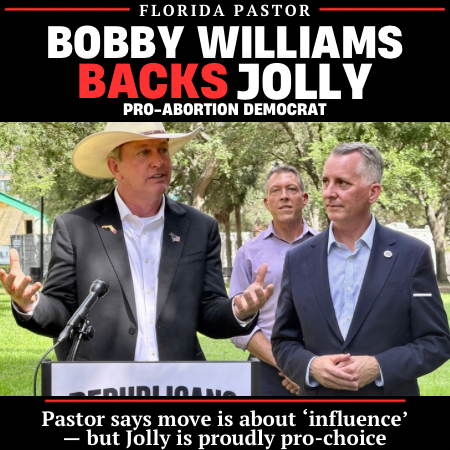
Florida Pastor Bobby Williams Backs David Jolly, Raising Questions Over His ‘God First’ Campaign
Staff Writer
Sep 15, 2026
FLORIDA — Former Republican gubernatorial candidate Bobby Williams built his campaign around a message he described simply as “God First.”
On his campaign website, Williams said his values were rooted in Christian principles and emphasized love, humility, accountability and service. He also said he embraced conservative ideals centered on family and personal responsibility.
Now Williams, a pastor who sought the Republican nomination for governor, has publicly backed Democratic gubernatorial nominee David Jolly.
Williams appeared at the launch of Republicans for Jolly in St. Petersburg, joining an effort aimed at Republicans willing to cross party lines in November.
Williams has made clear that his opposition to Republican nominee Byron Donalds is central to the move. But his endorsement of Jolly creates a significant contrast with the Christian and conservative message he presented to voters during his own campaign.
That contrast becomes especially clear on abortion.
Jolly explicitly identifies himself as pro-choice. On his campaign website, Jolly says he would replace Florida’s current six-week abortion restriction with a law modeled after the Roe v. Wade and Planned Parenthood v. Casey framework, allowing abortion until fetal viability, which his campaign places at approximately 23 to 24 weeks, with state regulation allowed afterward under limited circumstances.
Jolly has also addressed the religious component of that position directly. His campaign says he does not see a conflict between being Christian and serving as a pro-choice governor.
For many of the voters who supported Williams in the Republican primary, that is where the contradiction begins.
Williams did not campaign merely as a Republican who happened to be Christian. He made faith part of the campaign itself. His website prominently declared “God First” and said his political values were rooted in Christian principles.
At the Republicans for Jolly rally, Williams also criticized political hypocrisy, saying, “We’re tired of the hypocrites, we’re tired of what we’re getting today, we want somebody who’s going to fight for the people.”
The remark adds another layer to the questions surrounding his endorsement. Williams was criticizing hypocrisy while publicly lending his support to a candidate whose abortion policy stands in clear tension with the conservative Christian principles Williams placed at the center of his own campaign.
IRC Media asked Williams to explain his endorsement.
Williams framed his decision as a matter of Christian witness.
“My job is to be the light, the point of light is to shine in the darkness,” Williams told IRC Media. “If I’m not around the darkness, how can I impact it.”
Williams referenced Jesus going to Zacchaeus’ house and said he believes Christians must be present around people and institutions they hope to influence.
“I've not been invited in or around Byron's campaign,” Williams said. “So my job is to bring Jesus to politics, then I need to be around it.”
Williams’ response explains why he believes engagement with Jolly is justified.
What it does not fully explain is why that engagement required a public endorsement.
There is an important distinction between advising a candidate and endorsing one.
A pastor or conservative activist can meet with a candidate, challenge that person on abortion or other issues, pray with them, counsel them, and attempt to influence the conversation directly.
A public endorsement does something more.
It communicates to supporters that the endorsed candidate deserves consideration, credibility or support.
Thomas Kenny, president of the Republican Club of Indian River and editor-in-chief of The Sunshine Journal, who also holds a pastoral ordination, challenged Williams’ biblical comparison.
“Jesus hung out with the tax collector; he didn’t go to work for him,” Kenny told IRC Media.
Kenny also argued that Williams’ participation goes beyond simply being present around people with whom he disagrees.
“Endorsements equate to campaigning, especially when you launch ‘Republicans for Jolly’ with him as a keynote speaker,” Kenny said.
That distinction gets to the heart of the criticism Williams now faces: fellowship and influence do not necessarily require political endorsement.
Williams therefore is not simply choosing to be around someone with whom he disagrees. He has publicly lent his name, credibility and former candidacy to Jolly’s effort to attract Republican voters.
That distinction matters even more because Jolly’s abortion position is not a label being imposed by Republican opponents.
It is Jolly’s stated policy.
His campaign explicitly says he is pro-choice, opposes Florida’s six-week abortion law and supports restoring abortion access until fetal viability.
Williams is not required to support every Republican candidate, and criticism of Byron Donalds does not automatically place Williams at odds with his faith.
But refusing to support Donalds and publicly endorsing Jolly are two different decisions.
Williams says his purpose is to bring Christian influence into politics and to be a light in what he described as darkness.
The question for his former supporters is whether publicly endorsing Jolly advances that mission — or instead uses Williams’ own influence to help a candidate whose abortion policy conflicts with the principles Williams emphasized throughout his campaign.
Being a light to someone and endorsing that person for governor are two very different things.