


A COLLABORATION TO SPOTLIGHT THE MEDIA THAT MATTERS TO INDIAN RIVER AND BEYOND


Is Your Home Affected? Septic-to-Sewer Deadline Looms Along Florida's Indian River Lagoon
Staff Writer
Sep 6, 2026
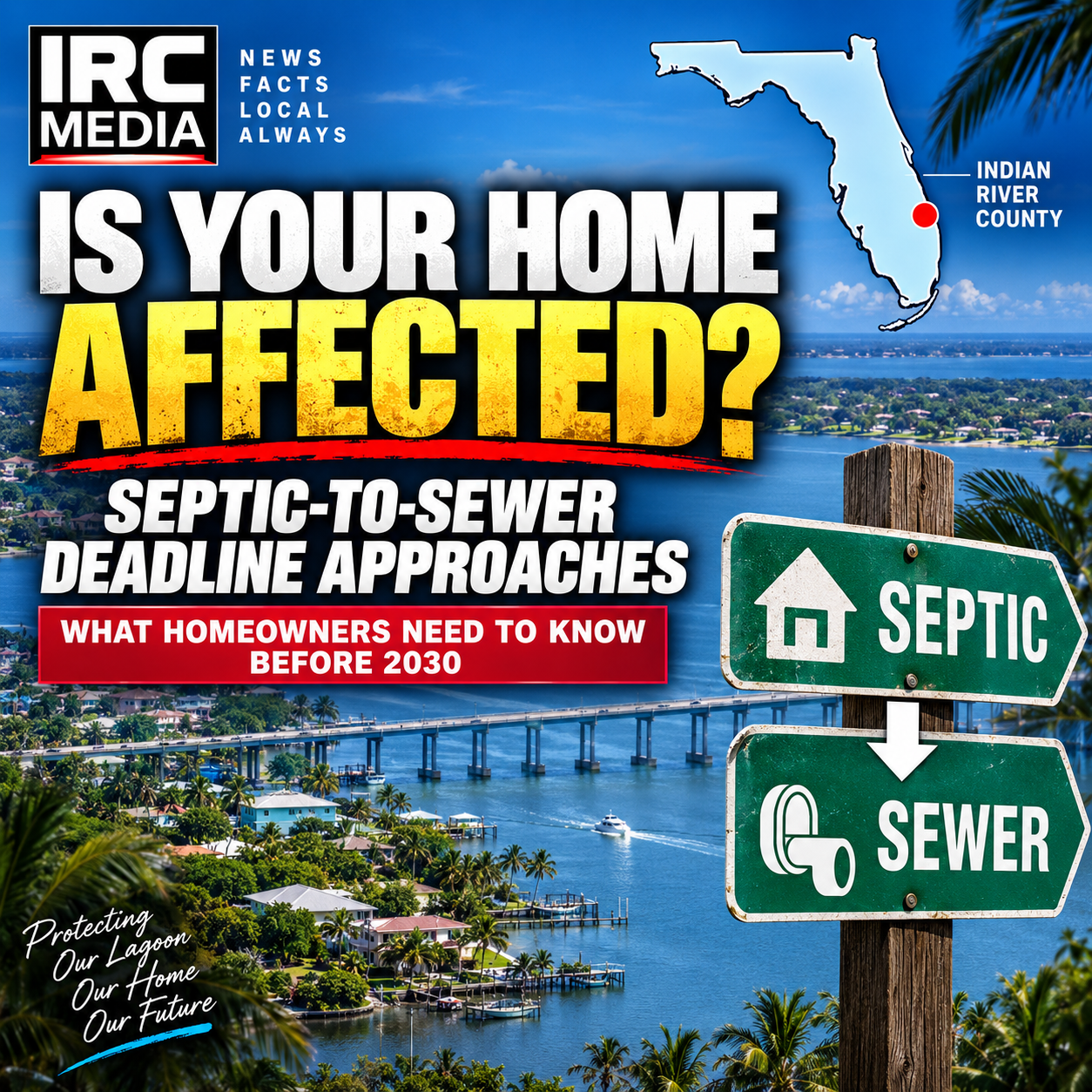
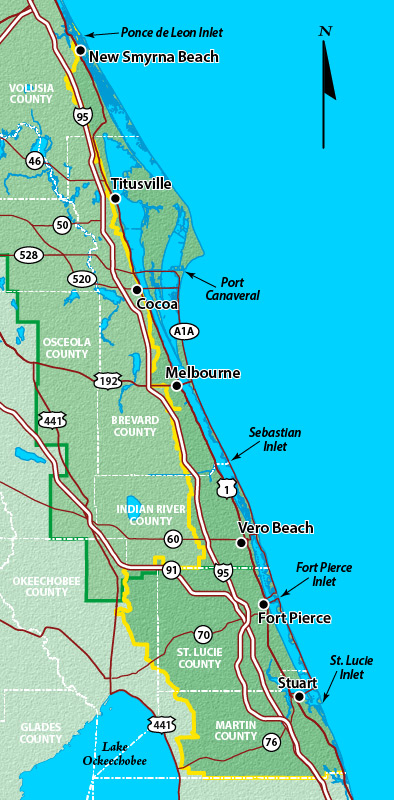
FLORIDA'S EAST COAST — A major wastewater deadline is approaching for homeowners along the Indian River Lagoon, with potentially affected properties extending through communities in Brevard, Indian River and St. Lucie counties.
Under Florida law, commercial properties and residential properties of 10 acres or less with existing septic systems inside the Indian River Lagoon Protection Program area must, by July 1, 2030, either connect to central sewer when it is available or upgrade to a qualifying nutrient-reducing wastewater system.
The mandate does not mean every homeowner with a septic tank in Brevard, Indian River or St. Lucie County must replace it. Whether a particular property is affected depends on its location within the state-defined protection program area and whether central sewer is available.
WHY IS FLORIDA REQUIRING THIS?
Florida created the Indian River Lagoon Protection Program after identifying onsite sewage systems, aging infrastructure, stormwater runoff, agriculture, fertilizer and other sources as contributors to excess nutrients entering the lagoon.
The program includes the Banana River Lagoon, Central Indian River Lagoon and North Indian River Lagoon Basin Management Action Plans, along with the Mosquito Lagoon Reasonable Assurance Plan.
The state says reducing nitrogen and phosphorus is necessary to improve water quality and protect the lagoon's habitat, recreation, fisheries and other resources.
ARE YOU AFFECTED?
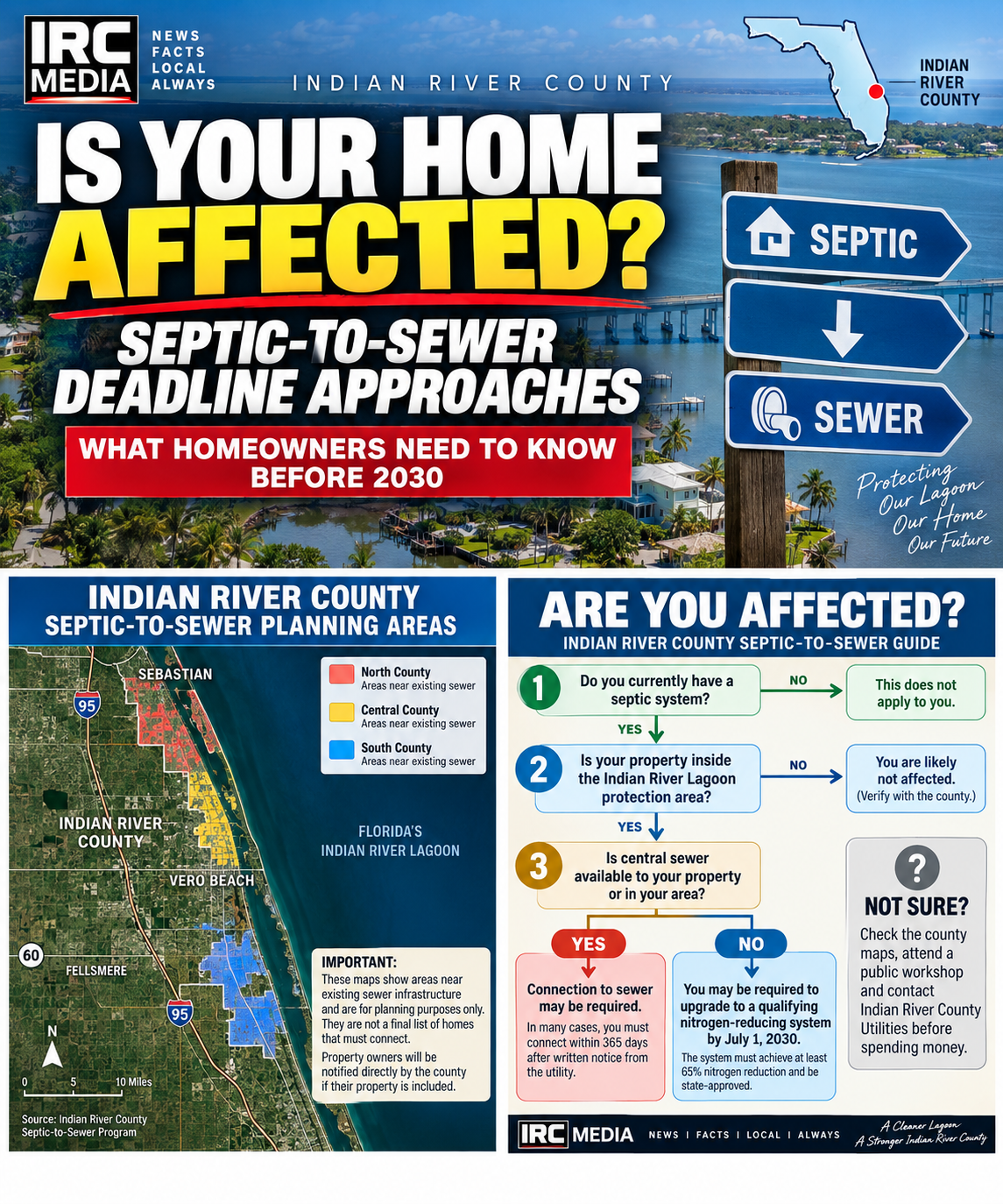
If you have an existing septic system, the next question is whether your property is located inside one of the Indian River Lagoon Protection Program areas covered by the law.
If it is, central sewer availability becomes critical.
Where central sewer is available, an affected property must connect by July 1, 2030. Where central sewer is not available, the law requires an enhanced nutrient-reducing onsite sewage system or another qualifying wastewater system that achieves at least 65 percent nitrogen reduction.
Homeowners should not spend money based solely on a social-media map or assume that living in one of these counties automatically places their property under the mandate. Confirm the status of your individual property with the appropriate state and local utility authorities.
BREVARD COUNTY
Brevard County's Save Our Indian River Lagoon program specifically advises residents that properties with existing septic systems inside the Indian River Lagoon Protection Program area face the July 1, 2030 requirement.
Brevard is already carrying out major sewer and septic-upgrade projects. The county's September 2026 project update lists construction or connection activity in areas including South Central Brevard, the South Beaches, Micco and Sykes Creek.
Brevard County tells residents to contact their local utility to determine whether sewer is available. Depending on where a resident lives, that could be Brevard County Utilities or a municipal utility serving communities such as Palm Bay, Melbourne, Titusville, Cocoa, Cocoa Beach, Rockledge, West Melbourne or Cape Canaveral.
INDIAN RIVER COUNTY
Indian River County is launching a countywide sewer conversion effort across its North, Central and South utility-service regions where centralized sewer is currently available.
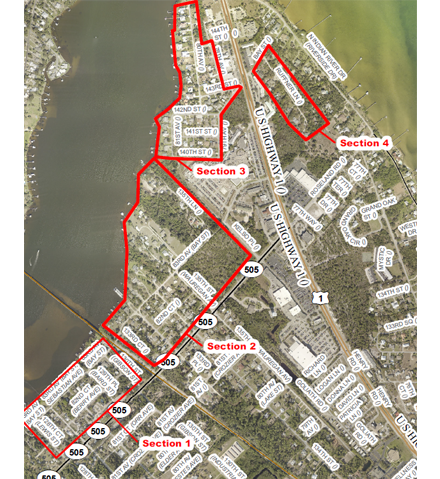
The county has published planning maps showing homes near existing sewer pipes. Those maps are useful for identifying areas under review, but they are not a final parcel-by-parcel list of homes required to connect.
Indian River County says it is still evaluating properties to determine which homes are readily available for connection. Property owners determined to be included will be notified directly.
Current local projects include Floravon Shores Phase 2, North Sebastian Phase 3, Wabasso Island and Hobart Landing. The county says the Hobart Landing project involves approximately 53 homes and is 75 percent funded through a Florida Department of Environmental Protection grant.
Indian River County is also holding free public workshops throughout September. The next workshop is Thursday, Sept. 10 at 5:30 p.m. at the Intergenerational Recreation Center, 1590 9th Street SW in Vero Beach.
Additional workshops are scheduled Sept. 14 in Sebastian, Sept. 15 and Sept. 22 at the Indian River County Main Library, Sept. 24 at the Intergenerational Recreation Center and Sept. 29 at the North Indian River County Library.
The workshops cover state requirements, project costs, financial assistance, property-owner responsibilities and the county's Sewer Connection Assistance Program.
ST. LUCIE COUNTY
St. Lucie County is also part of the Central Indian River Lagoon restoration effort, and septic-to-sewer work is underway in environmentally sensitive areas.
One major example is the North Hutchinson Island Septic Removal Project. St. Lucie County says the project is designed to replace approximately 530 septic tanks in four remaining neighborhoods with centralized sewer infrastructure, including roughly 340 septic systems directly adjacent to the Indian River Lagoon.
The county lists construction of the North Hutchinson Island wastewater collection system as in progress.
Residents in St. Lucie County should verify which utility serves their property and whether the property falls within the applicable Indian River Lagoon protection area before assuming the 2030 mandate applies to them.
WHAT WILL THIS COST?
There is no single price that applies to every homeowner.
Costs can depend on the utility, neighborhood project, distance to infrastructure, private-side plumbing, septic abandonment and available grants or assistance programs.
In Indian River County, officials say their September workshops will explain project costs, available funding and the Sewer Connection Assistance Program. Brevard County is also using its Save Our Indian River Lagoon program for sewer connections and higher-performing septic projects.
WHAT SHOULD HOMEOWNERS DO NOW?
If you live along the Space Coast or Treasure Coast and use a septic system, start by identifying your property and utility provider.
Then determine whether your property is within one of the state-defined Indian River Lagoon Protection Program areas. Next, ask your utility whether central sewer is currently available or planned for your property.
Keep any official notices you receive, and do not rely on a generalized county map as a final determination for your individual parcel.
THE BOTTOM LINE
The July 1, 2030 deadline is real, but it is not a blanket order requiring every septic system in Brevard, Indian River and St. Lucie counties to connect to sewer.
For affected properties inside the Indian River Lagoon Protection Program area, the path depends largely on sewer availability: connect to central sewer when available, or use a qualifying nutrient-reducing wastewater system when it is not.
IRC Media will continue following conversion programs across the Space Coast and Treasure Coast, including neighborhood maps, project costs, financial assistance and new notices to homeowners.