


A COLLABORATION TO SPOTLIGHT THE MEDIA THAT MATTERS TO INDIAN RIVER AND BEYOND


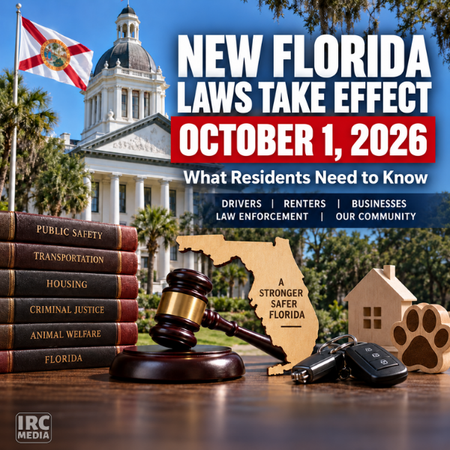
New Florida Laws Take Effect October 1: What Residents Need to Know
Staff Writer
Sep 20, 2026
The changes range from creating a new crime for violating certain court-ordered no-contact provisions to establishing felony penalties for fraudulent entry into rental housing and tightening restrictions involving nitrous oxide and xylazine.
Several measures have direct implications for law enforcement and the courts in Indian River County. Another law taking effect the same day is specifically local: legislation restructuring the Fellsmere Water Control District.
Here are some of the most important changes Floridians should know before October 1.
Violating certain pretrial no-contact orders becomes a separate crime
Under the Victim Safety in Pretrial Release Act, CS/CS/HB 397, a person who willfully violates a court-ordered no-contact condition while on pretrial release for certain violent offenses can now face a separate criminal charge.
The covered underlying offenses include murder, manslaughter, assault, aggravated assault, battery, aggravated battery, stalking, aggravated stalking, kidnapping, false imprisonment, sexual battery, certain lewd or lascivious offenses, robbery, written or electronic threats to kill or cause bodily injury, and other felonies involving the use or threat of physical force.
A first violation is a first-degree misdemeanor. A second or subsequent violation is a third-degree felony.
The law also permits an officer to make a warrantless arrest when there is probable cause to believe the new offense occurred.
Someone arrested for violating the provision must remain in custody until first appearance. The judge then determines whether pretrial detention or release with conditions is appropriate, with victim and public safety specifically included in the court's considerations.
For Indian River County, that could affect arrests handled by the Indian River County Sheriff's Office, Vero Beach Police Department and Sebastian Police Department, as well as bond and first-appearance proceedings involving the State Attorney's Office and local courts.
The change does not mean every violation of every pretrial condition automatically becomes a new criminal offense. The statute applies to specified no-contact conditions associated with the crimes listed in the law.
New xylazine trafficking penalties and nitrous-oxide restrictions
CS/SB 432, called “Meg's Law” in part of the legislation, makes several changes involving intoxicating substances.
One portion involving veterinary xylazine products actually took effect July 1. It exempts certain FDA-approved xylazine animal drugs used for legitimate veterinary purposes from Florida's Schedule I classification.
The major criminal provisions, however, take effect October 1.
Florida will establish specific criminal penalties for unlawfully selling, manufacturing, delivering or possessing xylazine with intent to sell, manufacture or deliver.
Trafficking begins at 28 grams. Depending on the amount involved, mandatory minimum sentences range from three years to 25 years, with fines reaching as high as $500,000.
The law preserves legitimate veterinary use while targeting xylazine intended for human use or illicit distribution.
The same legislation also affects nitrous oxide.
Licensed tobacco and nicotine-product dealers and their employees will generally be prohibited from possessing, selling, delivering or giving away nitrous oxide from their licensed premises. Violation is a third-degree felony.
There are exceptions, including for grocery stores and supermarkets, but the grocery-store exception does not extend to convenience stores. Finished food products that use nitrous oxide solely as a propellant are also excluded.
The Department of Business and Professional Regulation is directed to adopt rules aimed at preventing misuse of nitrous oxide for intoxication.
That portion may be particularly important for Treasure Coast retailers that sell tobacco or nicotine products alongside other merchandise.
Florida changes how criminal gang membership may be determined
CS/HB 429 updates the statutory criteria law enforcement and prosecutors may use in determining whether a person qualifies as a criminal gang member.
Florida law continues to require a person to meet at least two statutory criteria.
Beginning October 1, those criteria are revised to account more directly for online activity and other forms of evidence.
Among the updated factors are admissions of gang membership made in person or on social media, identification by a gang itself, identification by certain family members, specified communications showing gang affiliation, and use of gang-related language in furtherance of criminal gang activity online.
The legislation also reduces the number of documented observations with known gang members needed to satisfy one particular criterion from four to two.
The law defines “gang-related language” to include verbal, written or digital statements signaling gang affiliation, supporting gang activity or using recognized gang codes, symbols or terminology in connection with criminal gang-related activity.
The change can affect criminal investigations and charging decisions and can also have sentencing consequences under existing Florida gang statutes.
For agencies such as the Indian River County Sheriff's Office, Vero Beach Police and Sebastian Police, the law changes the statutory framework available in gang investigations. It does not by itself establish that any local agency has changed its policies or how it will apply the criteria.
Rental application fraud can become a felony
CS/HB 1293 creates the crime of fraudulent entry of a residential dwelling unit.
Beginning October 1, a person can commit a third-degree felony by knowingly and willfully obtaining possession of a rental home through specified identity-related fraud.
The law covers materially false written statements concerning a person's identity, forged or counterfeit documents such as a driver's license, identification card, bank statement or pay stub, and impersonating someone else in whose name the rental application was submitted.
Importantly, the offense requires both the fraudulent conduct and actually entering into and taking possession of the residential dwelling.
The legislation also changes landlord-tenant law.
Fraudulent entry is treated as a type of noncompliance that does not have to be offered an opportunity to cure. A landlord may terminate the rental agreement, with the tenant given seven days after notice to vacate.
For landlords and property managers, the law provides a new criminal and civil framework for certain fraudulent rental applications.
For renters, it means falsifying identity documents or impersonating someone else to obtain possession of a property can carry consequences far beyond losing the lease.
Vehicle and license-plate rules change
SB 488 is a broad transportation bill with provisions affecting motorists, commercial carriers and vehicle registration procedures.
For everyday drivers, one of the most visible provisions clarifies Florida's license-plate obstruction law.
A decorative plate frame or border is not automatically illegal as long as it does not obscure the license-plate number or the validation sticker.
The law also makes changes involving disabled-veteran license plates. Eligible veterans may retain their unique “DV” alphanumeric designation when a plate is renewed, transferred or reissued, and tax collectors are authorized to issue qualifying disabled-veteran plates on demand.
The legislation also makes significant technical changes affecting commercial motor carriers, fuel-use tax administration and motor-vehicle manufacturers.
A linked law, SB 490, creates a public-records exemption for certain email addresses collected by the Department of Highway Safety and Motor Vehicles and used for official electronic notifications.
For most Treasure Coast motorists, the practical takeaway is straightforward: decorative frames remain permissible, but the plate number and validation sticker still must remain visible.
Florida expands animal-cruelty laws and its animal-abuse database
CS/HB 559 makes several changes to Florida animal-welfare laws.
The legislation creates new third-degree felony offenses for adults who cause or entice a minor to commit — or commit in the presence of a minor — certain serious animal offenses.
Those include aggravated animal cruelty, animal fighting or baiting, and prohibited sexual activity involving animals.
The law also requires a juvenile who commits specified animal-cruelty offenses to undergo a psychological evaluation. Counseling or treatment must follow if recommended.
Florida's animal-abuse database will also become more detailed.
The Florida Department of Law Enforcement is required to post specified information on qualifying offenders, including names and aliases, date of birth, county of conviction, charges, case information, identifying marks or tattoos and a booking photograph.
Information generally remains posted for three years after a first misdemeanor conviction, five years after a first felony conviction and 10 years following a subsequent conviction.
Clerks of court and county detention facilities are required to provide the necessary information to FDLE.
The law also increases the maximum civil penalties counties and municipalities may authorize for certain local animal-control or animal-cruelty ordinance violations. The maximum may reach $2,500 for a first violation, $5,000 for a second and $7,500 for a third or subsequent violation.
Those higher amounts are authorization for local ordinances — they do not automatically mean Indian River County or its municipalities have adopted those maximum fines.
Career offenders face expanded registration requirements
CS/SB 1332 substantially revises Florida's Career Offender Registration Act.
The goal is to make several career-offender registration requirements more similar to those already used for registered sexual offenders and sexual predators.
Beginning October 1, qualifying career offenders must complete initial registration in person at a sheriff's office within the statutory timeframe.
The required information is expanded and can include employment information, vehicles used for employment, professional licenses and immigration status.
Career offenders also face additional requirements for reporting changes in registration information and annual re-registration.
The legislation changes driver-license and identification-card requirements and expands information sharing among law enforcement agencies, the Department of Highway Safety and Motor Vehicles, the Florida Department of Law Enforcement and correctional authorities.
Each failure to register or properly report required information can constitute a separate third-degree felony.
The law also increases the penalty for knowingly assisting a career offender in avoiding registration requirements from a first-degree misdemeanor to a third-degree felony.
For Indian River County, the Sheriff's Office is particularly relevant because the statute places additional registration duties at sheriff's offices statewide.
New felony involving lewd conduct while observing a child
CS/CS/HB 1525 creates a new third-degree felony involving certain lewd or lascivious conduct while observing a child younger than 16.
The offense applies when a person observes a child for the purpose of the offender's sexual arousal or gratification and intentionally exposes sexual organs in a lewd or lascivious manner or intentionally performs certain sexual acts without physical contact with the child.
The child does not have to be aware of the offender's conduct or see the offender's sexual organs for the statute to apply.
The law includes exceptions for breastfeeding and for mere nudity in a place set aside for that purpose.
The legislation also repeals an older Florida statute dealing with “unnatural and lascivious acts.”
New specialty license plates and changes to plate programs
CS/SB 246 changes Florida's specialty-license-plate program and authorizes several new designs.
Among the new plates authorized are plates connected to the Ultimate Fighting Championship, Miami Northwestern Alumni Association, Christopher Columbus High School, the United States Naval Academy, United States Military Academy, Miami Dade College, Florida Film Legacy and St. Petersburg College.
The law also creates an Endless Summer specialty plate for motorcycles.
Organizations behind newly approved specialty plates must provide the Department of Highway Safety and Motor Vehicles with a five-year financial projection within 60 days. Failure to provide the information can result in deauthorization of the plate.
The legislation also changes rules governing specialty-plate revenue and expands eligibility to purchase the Fraternal Order of Police specialty plate.
Motorists should not necessarily expect every newly authorized design to be physically available at tax collector offices on October 1. Authorization begins the statutory process, while DHSMV must still complete design and issuance requirements before plates become available.
A significant October 1 change is happening specifically in Fellsmere
One of the most locally significant laws taking effect October 1 may receive little attention outside Indian River County.
CS/HB 4093 changes the structure of the Fellsmere Water Control District.
The legislation makes the district a dependent district of Indian River County and places the Indian River County Board of County Commissioners in the role of the district's governing board.
It also revises district boundaries and contains provisions governing canals, access and public records.
The law's effectiveness was conditioned on companion legislation, HB 4095 or similar legislation, also becoming law. That condition was satisfied, with both measures enacted during the 2026 session.
Unlike the statewide criminal and consumer laws described above, this legislation is specific to Indian River County and could have direct implications for county government and property within the Fellsmere Water Control District.
What happens October 1
The practical impact of the new laws will vary.
Some create crimes that officers and prosecutors can enforce immediately. Others establish new procedures for courts, landlords, state agencies or sheriff's offices. Some, such as the specialty-license-plate legislation, authorize programs that still require administrative implementation before residents see the final product.
IRC Media found no subsequent legislative action changing the October 1 effective dates of the major enacted measures included in this report as of September 20.
That distinction matters because several other bills introduced during the 2026 session also contained proposed October 1 effective dates but never became law. Others were vetoed.
For residents, the biggest immediate changes include new consequences involving certain pretrial no-contact orders, rental fraud, xylazine trafficking and nitrous-oxide sales, as well as new rules affecting animal-cruelty cases and career-offender registration.
For Indian River County, the Fellsmere Water Control District legislation adds an unusually direct local-government change to the statewide laws arriving October 1.
IRC Media uses aggregated public data and verified sources; articles reviewed by editorial team to the best of our ability.
