


A COLLABORATION TO SPOTLIGHT THE MEDIA THAT MATTERS TO INDIAN RIVER AND BEYOND


New Florida Poll Shows Governor, Senate Races Nearly Tied — Other Polls Tell a Different Story
Staff Writer
Sep 19, 2026
FLORIDA — A new statewide poll is drawing attention after showing Florida's races for governor and U.S. Senate separated by less than a percentage point. But a look at other recent polling shows a considerably more complicated picture.
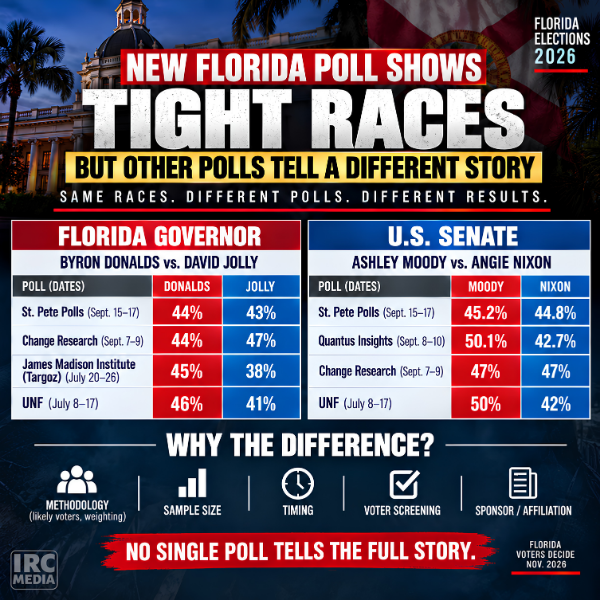
St. Pete Polls surveyed 913 likely Florida voters from Sept. 15–17 for Florida Politics. In the governor's race, Republican Byron Donalds received 44% and Democrat David Jolly 43%. In the U.S. Senate race, Republican Sen. Ashley Moody received 45.2% compared with 44.8% for Democratic Rep. Angie Nixon. The poll reported a margin of error of ±3.2 percentage points.
Those numbers differ from several other recent surveys.
THE SENATE RACE
Quantus Insights surveyed 733 likely voters Sept. 8–10 and found Moody at 50.1% and Nixon at 42.7%.
Change Research surveyed 1,107 likely voters Sept. 7–9 and found Moody and Nixon tied at 47%.
A University of North Florida Public Opinion Research Lab survey conducted July 8–17 among 848 likely voters found Moody at 50% and Nixon at 42%.
Taken together, the four surveys range from an essentially even race to an eight-point Moody advantage.
THE GOVERNOR'S RACE
The new St. Pete Polls survey has Donalds at 44% and Jolly at 43%.
Change Research's Sept. 7–9 survey measured Jolly at 47% and Donalds at 44%.
A Targoz Market Research survey conducted July 20–26 for the James Madison Institute found Donalds at 45% and Jolly at 38%.
UNF's July 8–17 survey measured Donalds at 46% and Jolly at 41%.
WHY CAN POLLS BE THIS DIFFERENT?
Different surveys can produce different results because of methodology, likely-voter screening, sample composition and weighting, how respondents are contacted, survey timing and ordinary sampling variation. Sponsorship and institutional affiliation are also useful context for readers evaluating a poll, although they do not by themselves determine whether a survey is accurate.
The newest St. Pete Polls results are within the survey's stated margin of error, meaning the poll does not establish a statistically clear advantage for either candidate in either race.
The broader collection of surveys shows why no single poll should be treated as a definitive picture of Florida voters. IRC Media will continue tracking polling in both statewide races and comparing new surveys as they are released.
IRC Media uses aggregated public data and verified sources; articles reviewed by editorial team to the best of our ability.
Did you know IRC Media is on Spotify too? In most cases, you can listen to our latest news articles on Spotify and get caught up on the stories that matter in just a few minutes. Follow IRC Media on Spotify and take the news with you wherever you go.