


A COLLABORATION TO SPOTLIGHT THE MEDIA THAT MATTERS TO INDIAN RIVER AND BEYOND


PawWatch Takes Aim at a Nationwide Problem: Finding Verified Animal-Cruelty Convictions
Rosa Barks
Sep 17, 2026
Animal-cruelty convictions are public record. Finding them, however, can be another matter entirely.
Depending on where a case occurred, information may be buried in court records, prosecutor releases, law-enforcement databases, state registries or other government systems. There is no single nationwide government database where a shelter, rescue, breeder, pet professional or member of the public can search verified animal-cruelty convictions across the United States.
A Florida family wants to change that.
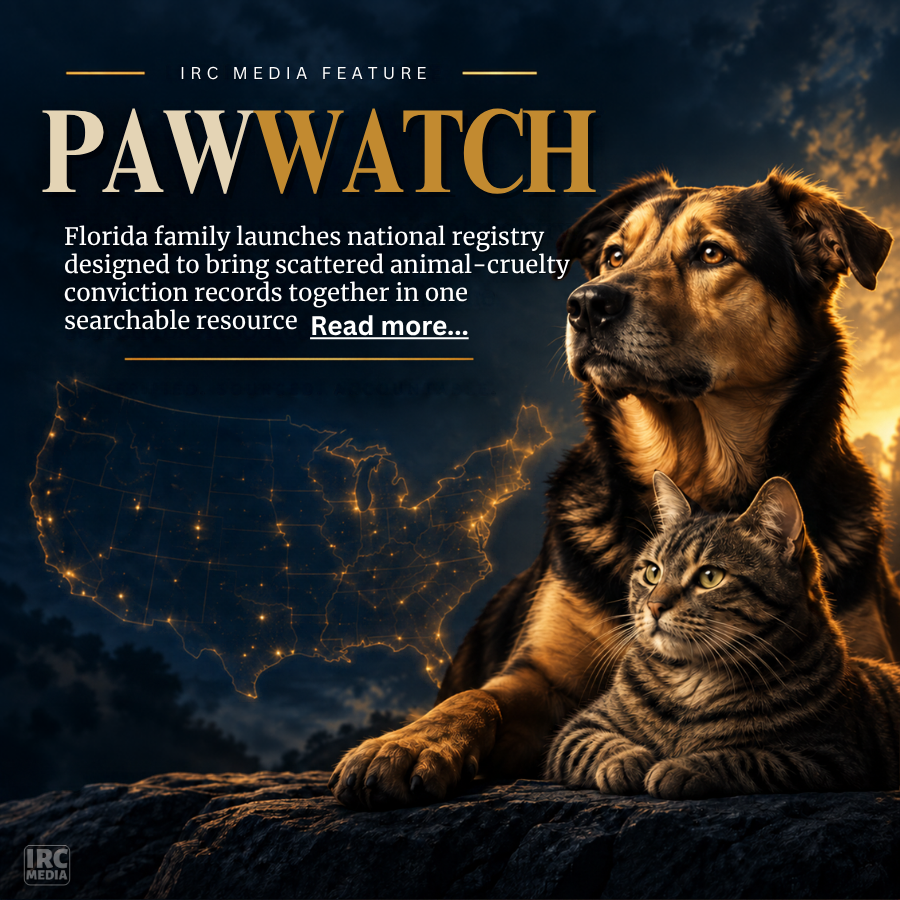
PawWatch LLC has launched PawWatchRegistry.com, a developing national registry designed to consolidate verified animal-cruelty convictions from official public sources into one searchable location.
The project is led by the Morvaji family, with Dale Morvaji serving as CEO of the Florida-based company.
For IRC Media co-founder Mike Bolack, Morvaji is also a familiar name.
Long before PawWatch, Morvaji appeared across multiple networks discussing cultural issues and current events, often alongside Mike. The two have appeared and co-hosted together on numerous occasions dating back to their earlier years in broadcasting and commentary.
PawWatch represents a very different undertaking for Morvaji and his family — one centered on making documented information about animal cruelty easier for the public to locate.
Convictions, Not Accusations
One of the most important distinctions PawWatch makes is what does — and does not — qualify someone to appear in its registry.
An accusation is not enough.
Neither is an arrest.
PawWatch says it publishes records only after a final animal-cruelty conviction can be supported by an official source.
Pending charges, social-media accusations, anonymous claims, sealed matters, minors and cases that cannot be confidently matched to a final conviction are excluded from registry profiles.
The official sources PawWatch uses can include courts, prosecutors, law-enforcement agencies, corrections agencies and government-maintained registries.
That verification standard is a central part of what PawWatch is trying to build.
Animal-abuse allegations can generate intense public reaction, particularly once photographs, videos or claims begin circulating online. PawWatch is intentionally drawing a line between allegations and documented convictions.
Its approach is simple: if the conviction cannot be verified, it does not become a PawWatch registry record.
Bringing Scattered Records Together
The challenge PawWatch is addressing is not necessarily that the information does not exist.
The problem is where it exists.
An animal-cruelty conviction in one state may be documented very differently from a conviction in another. Even within the same state, records may be distributed among different courts, counties and agencies.
Someone searching for that information may need to know where an offense occurred, which agency handled the case and which database contains the final disposition.
PawWatch is attempting to create a national public-information layer over those individual systems.
Visitors will eventually be able to search the developing registry by state or by an individual's name and review the official source supporting a published record.
PawWatch says every published profile must be traceable to an official public record.
The registry also deliberately limits the personal information it publishes. City and state may be displayed, but private street addresses are not.
A National Project Being Built State by State
PawWatch is not presenting its current database as complete.
That's important.
The organization says nationwide research is underway, with historical reviews working through official records beginning with 2020. States where research remains incomplete are identified as coverage gaps rather than being filled with names that have not been adequately verified.
Some of that work is already visible.
PawWatch's Delaware registry currently contains dozens of verified conviction records and identifies the official sources reviewed as well as known gaps in the state's available records.
Maryland, meanwhile, currently has far fewer published records and is explicitly labeled as still undergoing review.
That transparency gives users a clearer picture of what has — and has not — been researched.
Building the registry will take time.
Across 50 states, courts and government agencies maintain records through different systems, under different laws and with dramatically different levels of public accessibility.
PawWatch will also have to do more than simply add names.
Records can change.
Convictions can be corrected, vacated or expunged. Identities can be confused. Government source pages can disappear.
PawWatch says published records are therefore subject to continued review, and the organization maintains a correction and removal process for information that later changes or is determined to be inaccurate.
More Than a List of Names
The potential usefulness of a centralized resource extends beyond general curiosity.
Shelters and rescue organizations regularly make decisions about where animals will be placed.
Foster organizations must decide who will have animals inside their homes.
Breeders and private owners make similar decisions when transferring animals to new owners.
Pet professionals may also want information about individuals who will have access to animals.
PawWatch describes its registry as another tool those groups can use while making those decisions.
It is not intended to replace an official court record or serve as a complete background check.
Instead, PawWatch provides a starting point — identifying documented convictions and directing visitors to the official source supporting the information.
That distinction also matters in the opposite direction.
A person not appearing in PawWatch should not automatically be assumed to have no criminal history. Particularly while nationwide coverage is still being built, an empty search result may simply mean the relevant jurisdiction has not yet been completely reviewed.
A Florida Family With a National Goal
PawWatch LLC was established in Florida in 2025, with members of the Morvaji family filling leadership roles in the company.
What they are attempting now reaches well beyond Florida.
The long-term goal is a registry where a rescue organization in Florida, a breeder in Texas or a shelter in Delaware can begin searching the same national resource rather than navigating an entirely different system for every jurisdiction.
It's an ambitious project.
There are thousands of courts, prosecutors and government agencies across the country, and there is no universal system for how animal-cruelty convictions are categorized or published.
But that fragmentation is also the reason PawWatch exists.
The records are already public.
PawWatch is working to make them easier to find, verify and understand.
For Morvaji, it marks another chapter after years spent behind microphones discussing the issues of the day.
This time, he and his family aren't simply talking about a problem.
They're building something they hope can help address one.
Visit PawWatchRegistry.com to learn more or follow the registry as nationwide coverage expands.