


A COLLABORATION TO SPOTLIGHT THE MEDIA THAT MATTERS TO INDIAN RIVER AND BEYOND


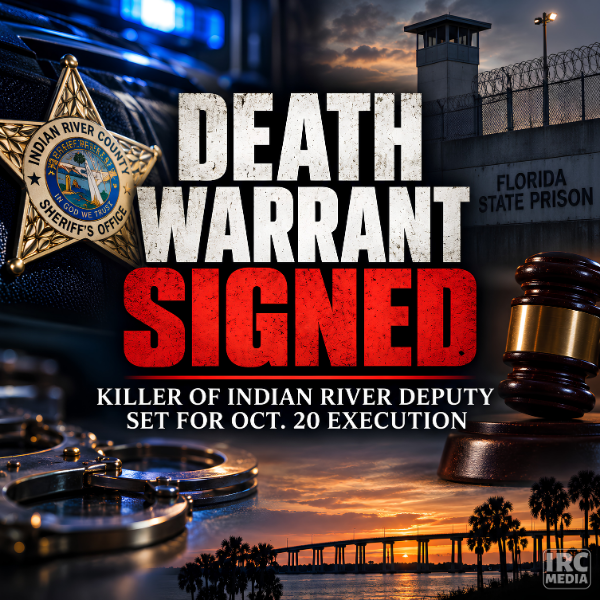
DeSantis Signs Death Warrant for Killer of Indian River County Deputy Richard Raczkoski
Staff Writer
19 de set. de 2026
VERO BEACH, Fla. — Nearly four decades after Indian River County Sheriff’s Deputy Richard “Raz” Raczkoski was shot and killed while responding to a 911 call, Florida Gov. Ron DeSantis has signed a death warrant for the man convicted of his murder.
William Reaves Jr., 77, is scheduled to be executed by lethal injection at 6 p.m. Tuesday, October 20, at Florida State Prison.
For Indian River County, the warrant brings renewed attention to a murder that has remained part of the Sheriff’s Office’s history for nearly 40 years.
The Murder of Richard “Raz” Raczkoski
Shortly after 3 a.m. on September 23, 1986, Raczkoski responded to a 911 call from a pay phone outside a Zippy Mart near Vero Beach.
Court records show Reaves had been trying to get a taxi and called 911 after running out of change. Raczkoski arrived to investigate and spoke with Reaves while helping determine whether a taxi was coming and checking whether Reaves had outstanding warrants.
According to Reaves’ statements documented in court records, a handgun fell from his shorts while the two men were talking. A confrontation followed as Raczkoski attempted to prevent Reaves from retrieving the weapon.
Reaves recovered the gun. Evidence presented at trial showed that as Raczkoski backed away and then ran, Reaves fired seven rounds. Raczkoski was struck four times and died later that morning.
Reaves fled the scene and was eventually arrested.
Raczkoski was 29 years old.
Known as “Raz” to family, friends and fellow officers, Raczkoski began his law-enforcement career in 1979 and joined the Indian River County Sheriff’s Office in 1983. His only son was born after his death.
His legacy remains visible in Indian River County. A section of State Road 60 bears his name, and the Sheriff’s Office has restored a 1986 Ford Crown Victoria patrol car in his honor.
A Conviction Reversed — Then Reaves Was Convicted Again
Reaves was initially convicted of premeditated first-degree murder in 1987 and sentenced to death.
That conviction was overturned by the Florida Supreme Court in 1991 — not because the court found Reaves innocent, but because of a conflict involving the prosecution.
The Florida Supreme Court determined that a prosecutor involved in Reaves’ murder case had previously represented Reaves while serving as an assistant public defender in an earlier criminal case and had access to privileged information. The court ruled that the trial court should have granted Reaves’ request to disqualify the prosecutor and ordered a new trial.
Reaves was retried in 1992. A second jury convicted him of first-degree murder and recommended death by a 10-2 vote. The trial judge imposed the death sentence.
The Florida Supreme Court affirmed that conviction and sentence in 1994.
Decades of Appeals
Over the following decades, Reaves pursued numerous state and federal challenges to his conviction and death sentence.
Among the issues raised were claims concerning his trial representation, drug use, mental-health evidence and his military service in Vietnam.
Court records show that a psychologist who evaluated Reaves diagnosed him with antisocial personality disorder, polysubstance abuse and what the psychologist described at the time as a subclinical form of post-traumatic stress disorder associated with his Vietnam service.
Reaves argued in federal court that his trial attorney had failed to adequately investigate and present evidence concerning his mental health, military history and substance abuse.
Those arguments produced years of additional litigation. A federal district court ultimately granted habeas relief, but the U.S. Court of Appeals for the Eleventh Circuit reversed that decision in 2017 and ordered that relief be denied.
Reaves later sought a new sentencing proceeding following the U.S. Supreme Court’s decision in Hurst v. Florida, which struck down portions of Florida’s former death-penalty sentencing system.
The Florida Supreme Court rejected Reaves’ claim in 2018, holding that Hurst did not apply retroactively to his sentence because it became final in 1994.
Flowers Had Publicly Called for the Execution
Indian River County Sheriff Eric Flowers has publicly pushed for Reaves’ execution in recent years.
Flowers said the governor’s office contacted him Friday morning to tell him DeSantis had signed the warrant.
“This month is the 40-year anniversary of Raczkoski being killed,” Flowers said following the announcement.
Flowers has said he intends to attend the execution.
“The execution of Reaves is long overdue,” Flowers told Sebastian Daily. “For 40 years Reaves has lived while justice for Raz waited. On October 20th I will be in attendance to make sure the last thing Reaves sees is an Indian River County Sheriff’s Office uniform.”
Flowers, who was a child when Raczkoski was killed and never personally knew him, has said retired members of the agency continue to share stories about “Raz.”
The sheriff also contacted Raczkoski’s son and retired members of the agency after learning the warrant had been signed.
Is the Execution Currently Stayed?
As of September 19, IRC Media found no court order staying Reaves’ October 20 execution.
Florida Attorney General James Uthmeier advised the governor before the warrant was issued that the legal record supported issuance of a death warrant and that no court had an existing stay of execution in the case.
Reaves’ attorneys, however, have already begun new warrant-related litigation.
After the warrant was signed, defense counsel filed an emergency motion seeking to stay the warrant proceedings and suspend the court’s expedited briefing schedule. The attorneys argued that they are simultaneously representing another Florida death-row prisoner in active warrant proceedings and cannot adequately handle both cases at the same time.
The filing does not itself stop the execution.
The Florida Supreme Court established an accelerated schedule under which circuit-court proceedings are expected to conclude October 2, followed by expedited appellate briefing.
Additional state or federal challenges could therefore still be filed or decided before October 20.
Four Decades Later
The timing places the case back before Indian River County almost exactly 40 years after Raczkoski’s death.
September 23 marks four decades since the 29-year-old deputy responded to what began as a routine 911 call and never returned home.
For the Sheriff’s Office, Raczkoski’s death has remained part of the agency’s institutional memory through annual remembrances, the restored patrol car and the highway carrying his name.
Now, after two trials and decades of state and federal litigation, the state has scheduled Reaves’ execution.
Unless a court intervenes or the warrant is otherwise stayed, William Reaves is scheduled to be executed at 6 p.m. October 20.
IRC Media uses aggregated public data and verified sources; articles reviewed by editorial team to the best of our ability.