


A COLLABORATION TO SPOTLIGHT THE MEDIA THAT MATTERS TO INDIAN RIVER AND BEYOND


Lindsay Clancy Is on Trial — So Why Is Her Husband Being Blamed?
Staff Writer
1 sept. 2026
UPDATE — JURY REPORTS IT CANNOT REACH A UNANIMOUS VERDICT
Tuesday, Sept. 1 — The jury deciding the fate of Lindsay Clancy has told Judge William Sullivan that it cannot reach a unanimous verdict, marking the most significant development yet on Day 4 of deliberations.
Rather than ending the case, Sullivan sent the jurors back to continue deliberating in an effort to reach a unanimous decision.
The development does not mean a mistrial has been declared, nor has the jury been formally discharged as a hung jury. Deliberations are continuing.
Jurors had already spent approximately 17 hours over the first three days weighing whether Clancy should be held criminally responsible for killing her three children — Cora, 5, Dawson, 3, and Callan, 8 months — or whether her mental illness left her not criminally responsible.
Both sides agree that Clancy killed the children. The central question before the jury is her legal responsibility at the time. Her defense argues that postpartum psychosis left her unable to appreciate the wrongfulness of her actions, while prosecutors maintain that despite her mental illness, she understood what she was doing and knew it was wrong.
The jury may consider first-degree murder, second-degree murder, manslaughter, or a finding that Clancy lacked criminal responsibility because of mental illness.
For now, there is still no verdict. The jury has been instructed to continue deliberating.
— ORIGINAL ARTICLE CONTINUES BELOW —
There is no dispute over one of the most horrifying facts in the Lindsay Clancy murder trial: Clancy killed her three young children.
Her attorneys acknowledge it. Prosecutors acknowledge it. Clancy herself has admitted it.
Cora, 5, Dawson, 3, and Callan, 8 months, died after being strangled inside the family's Duxbury, Massachusetts, home in January 2023.
The question being decided at Clancy's trial is whether she was criminally responsible for those killings or whether severe mental illness left her legally insane at the time.
Yet outside the courtroom, another trial has been taking place on social media.
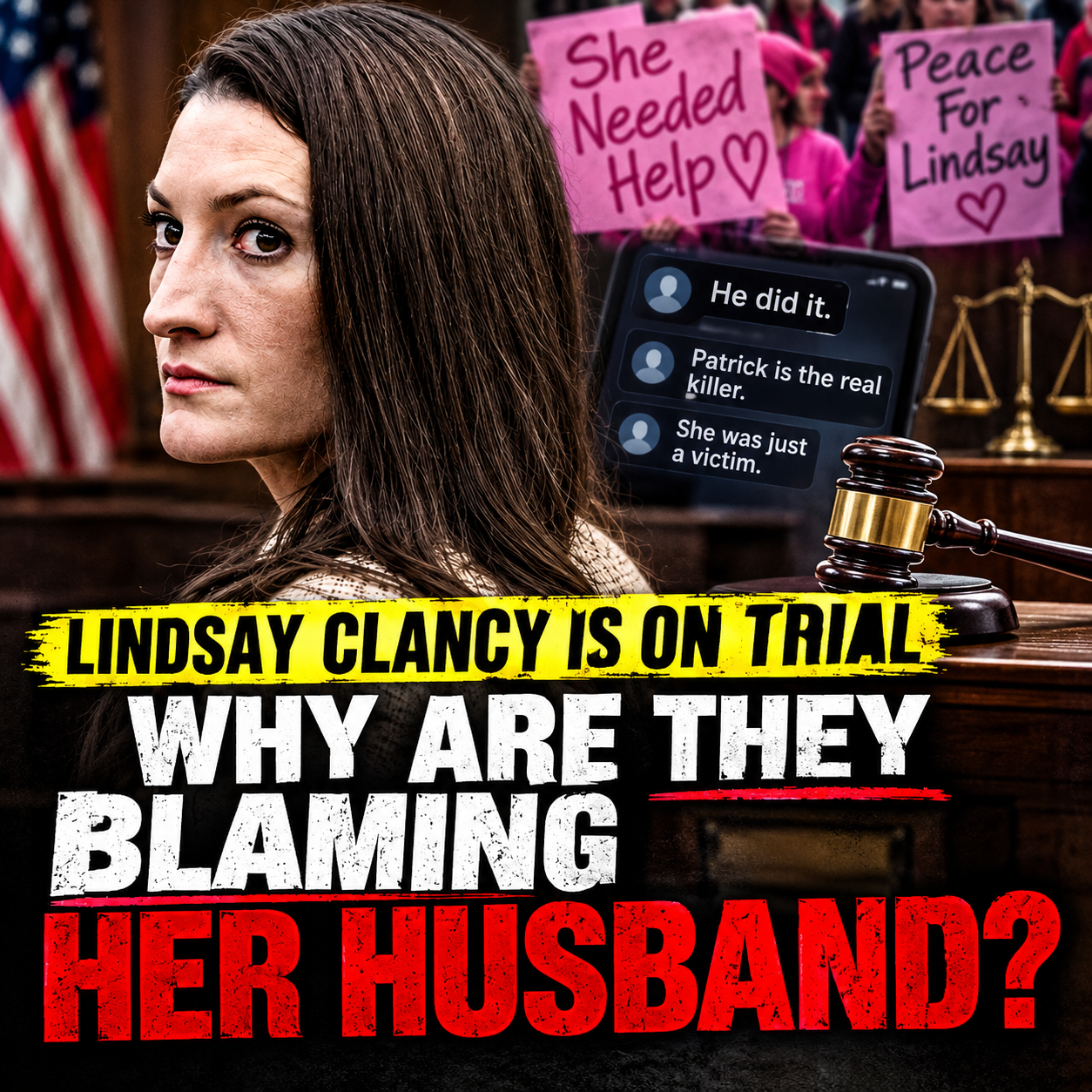
And in that version of the case, an increasingly vocal group of Clancy supporters — many of them women — has directed suspicion, anger and even accusations of murder toward someone who isn't on trial at all: the children's father, Patrick Clancy.
From Mental-Health Advocacy to Conspiracy Theories
There is an important distinction between believing Lindsay Clancy suffered from postpartum mental illness and claiming she didn't kill her children.
Her defense maintains that Clancy was suffering from psychosis and experienced a command hallucination when she killed Cora, Dawson and Callan.
That argument has been supported by defense experts and has resonated deeply with women who experienced postpartum depression, psychosis, intrusive thoughts or inadequate mental-health treatment themselves.
Hundreds of supporters — many dressed in pink — have gathered outside Plymouth Superior Court carrying messages including "She Needed Help" and "Peace For Lindsay.
Their argument is largely about mental illness and criminal responsibility.
But something considerably different has emerged online.
TikTok, X, Reddit and other platforms have filled with theories accusing Patrick Clancy of neglecting his wife, contributing to the deaths or, in the most extreme examples, actually killing his children and framing Lindsay.
There is no evidence presented in court supporting those allegations.
Patrick Clancy has never been identified as a suspect in his children's deaths.
Investigators used surveillance footage and phone records to corroborate that Patrick was away from the house when the children were killed. He had left at Lindsay's request to pick up medication at CVS and takeout food before returning home to a nightmare.
Nevertheless, the accusations continue.
Some Theories Have Become Extraordinary
The online speculation has moved far beyond legitimate questions about postpartum healthcare.
The Boston Globe documented one X user who claimed Patrick drugged Lindsay, pushed her from a window and strangled the children so he could eventually marry another woman.
No evidence supporting that claim has been introduced at trial.
CNN has documented online users questioning whether Lindsay committed the crimes at all despite the defense and prosecution agreeing that she did.
WIRED examined a large community of predominantly female TikTok users who have attempted to assign responsibility to Patrick — either by portraying him as a neglectful husband or by advancing theories that he actually committed the murders.
Some of the reasoning circulating online has become almost impossible to reconcile with evidence.
Reports have highlighted screenshots circulating from TikTok in which Clancy supporters reportedly invoked the couple's zodiac signs.
One comment declared that "Leos don't kill their cubs."
Another reportedly concluded that because Lindsay is a Leo and Patrick is a Gemini, "He did it."
That is how far portions of the online conversation surrounding three dead children have traveled from the evidence being presented inside a courtroom.
Patrick's Actions Have Been Put Under a Microscope
Patrick's conduct before the killings has nevertheless received legitimate scrutiny during the trial.
Defense attorney Kevin Reddington questioned him about occasions when he traveled, went skiing or attended brunch while Lindsay was struggling with her mental health.
CNN correspondent Jean Casarez noted that the questioning appeared designed to explore whether Lindsay had adequate support during a period when she was seeking psychiatric treatment.
Those are questions attorneys are entitled to ask.
They are not evidence that Patrick murdered his children.
In fact, Reddington's questioning also highlighted an important fact: Patrick had previously been away for considerably longer periods while Lindsay remained alone with the children.
If the defense wanted jurors to believe Lindsay had been secretly planning to kill them, Patrick's absence during those earlier periods could seemingly have provided an opportunity.
Instead, the defense maintains that Lindsay experienced a catastrophic psychotic break on the night the children died.
That is dramatically different from claiming Patrick committed the killings.
The Evidence the Jury Is Actually Considering
Inside the courtroom, the argument is far more serious than much of what is circulating online.
Defense psychiatrist Dr. Phillip Resnick testified that Clancy was psychotic and believed killing the children was necessary to protect them.
Prosecutors have challenged that conclusion.
Forensic psychologist Dr. Kirk Heilbrun testified this week that although Clancy suffered from mental illness, he believed she remained capable of understanding what she was doing and recognizing that it was wrong.
He concluded that she was criminally responsible.
FBI forensic psychiatrist Dr. Gregory Saathoff also questioned portions of Clancy's description of hearing a voice directing her to kill the children.
Those competing expert opinions represent the actual question jurors must answer.
Not Patrick's zodiac sign.
Not TikTok theories.
Not whether someone online believes Patrick behaved like the husband they think he should have been.
The jury must decide whether Lindsay Clancy was legally responsible for what she admittedly did.
Sympathy Is Not Evidence
Perhaps the extraordinary reaction to the Clancy case reveals something larger about how Americans view motherhood.
For some women who experienced frightening postpartum symptoms themselves, Lindsay's story may feel deeply personal.
They may recognize the exhaustion, depression, anxiety, intrusive thoughts or sense that medical professionals weren't listening.
Those experiences deserve to be taken seriously.
But empathy for women suffering from postpartum mental illness does not require abandoning the evidence surrounding the deaths of Cora, Dawson and Callan.
It also does not justify accusing their surviving father of murdering them without evidence.
Patrick returned home that evening and discovered his wife outside after she had jumped from a second-story window.
He then discovered his children.
His 911 call and reaction to finding them became evidence at trial.
He has since endured not only the deaths of all three of his children, but an internet ecosystem in which strangers dissect his movements, relationships, facial expressions, clothing and personal life searching for clues to a crime investigators say he did not commit.
Social Media Has Created a Different Courtroom
High-profile criminal cases have always attracted amateur detectives.
Social media has changed the scale.
A theory that once might have remained between a handful of people can now reach millions through TikTok, X, YouTube or Reddit before anyone asks whether the underlying claim is true.
Sensational theories generate engagement.
Engagement generates distribution.
And repetition can make speculation begin to resemble evidence.
That appears to be happening in the Clancy case.
The legitimate debate over postpartum psychosis, psychiatric treatment and criminal responsibility has increasingly become entangled with an online campaign in which some people appear determined to find another person responsible for what happened.
But the legal case remains much simpler.
Lindsay Clancy killed Cora, Dawson and Callan.
Her attorneys say she was insane when she did it.
Prosecutors say she was mentally ill but still understood her actions and should be held criminally responsible.
The jury will soon decide between those positions.
Whatever verdict they reach, it should be based upon the evidence presented in that courtroom — not the viral theory that received the most likes on TikTok.
IRC Media uses aggregated public data and verified sources; articles reviewed by editorial team to the best of our ability.